Here is an excerpt from a night diving narrative by Mark Dhruv:
“As my buddy and I neared the rocking and rolling boat, I noticed that the other two divers had already climbed aboard and were staring intently into the water. One of the divers casually waved his hand in the water, stirring up the phosphorescence. The little organisms flashed their homemade lights, giving the microscopic phytoplankton an enhanced presence. Classified in the botanical world as peridinians they produce a heatless light by a relatively simple chemical process. These amazing forms of algae flourish throughout the world’s oceans. Known to many as the ocean’s “night light”, or bioluminescence, a tiny particle of phytoplankton reveals a striking display of light virtually incomparable in the natural world.
As my arms swept through the water, pushing me slowly to the boat, I noticed that the bioluminescence created a fan of light in my arm’s wake giving me the image of a wizard casting a spell of fire as he waved his wand through the air. The effect was captivating, occupying my thoughts until I finally reached the boat. Handing my weightbelt to Mike, the divemaster, I struggled in the rough waters to pull off my Buoyancy Compensation Device, usually called a B.C. Suddenly I heard one of the divers exclaim, “What the hell is that?!”
What the hell is that? Is not something you want to hear when you are still in the water, your feet dangling like tasty morsels six feet below, and it’s dark with two-foot waves. Freezing my arms in their contorted position, I spun around in the water, scanning the near blackness for any sign of danger—something like a fin.
“It was huge!” The other diver shouted, somewhat excitedly. Behind me was my dive buddy, oblivious to the sudden panic erupting aboard the panga as he casually began to take off his weightbelt. Seeing nothing, I forced my B.C. and tank off and handed it up to Mike. Practically throwing it aside instead of placing it in the tank rack, he grabbed my arm and hauled me aboard, utilizing strength I didn’t know he had. As I rolled out of the way, I heard him yell to my buddy to hand up his equipment. Though his face was one of cool composure, his actions betrayed his panic. The first diver yelled again, this time with a definite edge of panic, “There it goes again! Look at it!”
When I gained a sitting position in the cramped boat, I looked out over the water for any sign of something… huge. What I saw fascinated and frightened me at the same time. It was a glow about twelve feet long and about half again as wide. The illumination moved underneath the boat, from one side to the other, similar to the dive lights from multiple divers except at an amazing speed. For a moment I thought, spooky, until I realized that the glow was just the phosphorescence stirred up by whatever was down there. But what exactly was down there? In hindsight we probably should have stayed calm, watched the light show with fascination and leisurely made our way back to our beach camp. But when the wind is whipping up the waves, you’re cold and tired from a difficult dive in strong currents and throw in the powerful presence of a dark night in a foreign place, well… things can get a little distorted.
Mike had finally pulled my partner out of the water and then scrambled to the back of the boat. As the vessel’s dive master, his impeccable rescue training kicked into action. He was thinking only of the potential danger to his clients. Ignoring his own curiosity he yelled for me to pull up the anchor, which I immediately started to do. As the boat’s six occupants hung on to the sides of the rolling panga, Mike hit the electric start button on the always-faithful Mercury motor.
I’m still amazed that out of the twenty or so times I had been in that boat, this cold, wet night was the only time the engine did not start on the first try. Or the second. Or the third. Maybe in his panic he was releasing the start button too quickly. Or maybe the motor was cold. But what-ever the reason, the horror movie cliché of the victim’s car not starting as the killer advanced seemed to be happening to us—and this was no movie.
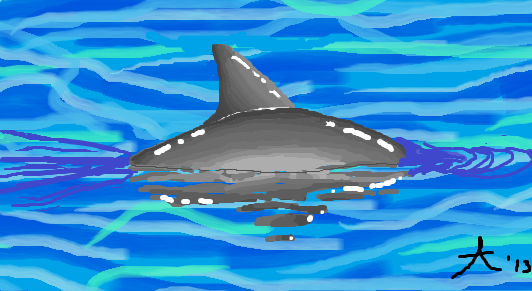
I finally got the anchor aboard just as the motor roared into life. The weird glow had once again passed by the boat, this time chased by another apparent sea monster. This one had a fin.
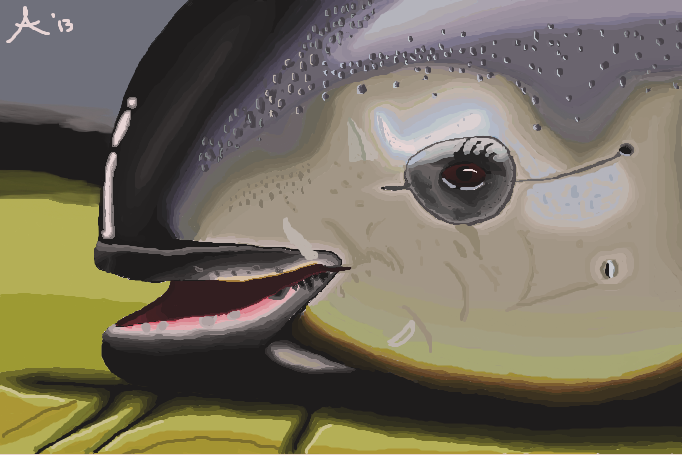
“Let’s go! Let’s go! Let’s go!” The divers were now a bit frightened as most of us watched the fin sink below the surface. With my background in marine biology, I felt I had a little better handle on the situation and shark! was the first thing on my mind. What was on their’s, I didn’t even want to consider. Mike hit the throttle and the Mercury shot us forward into the rising swells. The second time the monster with the fin appeared, I finally realized what it was: a Vaquita. The porpoise, whose name means “little cow” in Spanish, snorted out a spray of water from its blowhole and dived back beneath the surface, giving me a good look at it. Being approximately five feet long, the dark-colored marine mammal was once a common sight in the gulf.
The Vaquita had been following a school of fish, which was causing the eerie glow but now latched onto our wake, curious about our presence. As the world’s smallest porpoise, it is an endangered species found only in the northern portion of the Sea of Cortez. Its threatened population has been declining due to heavy commercial fishing. The incidental catch of these mammals in gill nets, and other changes in the ecology of the gulf due to human interference, have decimated its population. How many of the small porpoises exist is not known for certain but estimates place them at around 200 to 500. Though protected by the Endangered Species Act, its preservation cannot be ensured unless adequate law enforcement is implemented.
As we neared our campsite, the protective cove smoothed out the waves and reduced the wind, bringing our heart rates back to normal. The Vaquita followed our boat to within a couple hundred yards of the beach before turning back to the deeper waters of the Sea of Cortez. We all watched it go, its occasional breath audible for a few more minutes as we tried to catch a glimpse of its fin in the partial moonlit darkness. We all appreciated the presence of the Vaquita. Though our dive had been a bust, our companion back to the beach was a pleasant surprise. None of us could possibly know if future generations would have this same experience. At the rate of decline (about 50 per year are accidentally caught by fishermen) it is entirely possible these amazing creatures may not be around in the next ten to twenty years.”
I was so surprised when I read this. If these people really did see a Vaquita, they got perhaps the best view of all time. Read the rest of this cool report from a while ago: http://www.travel-watch.com/Sea-of-Cortez.htm.
 V-log
V-log 