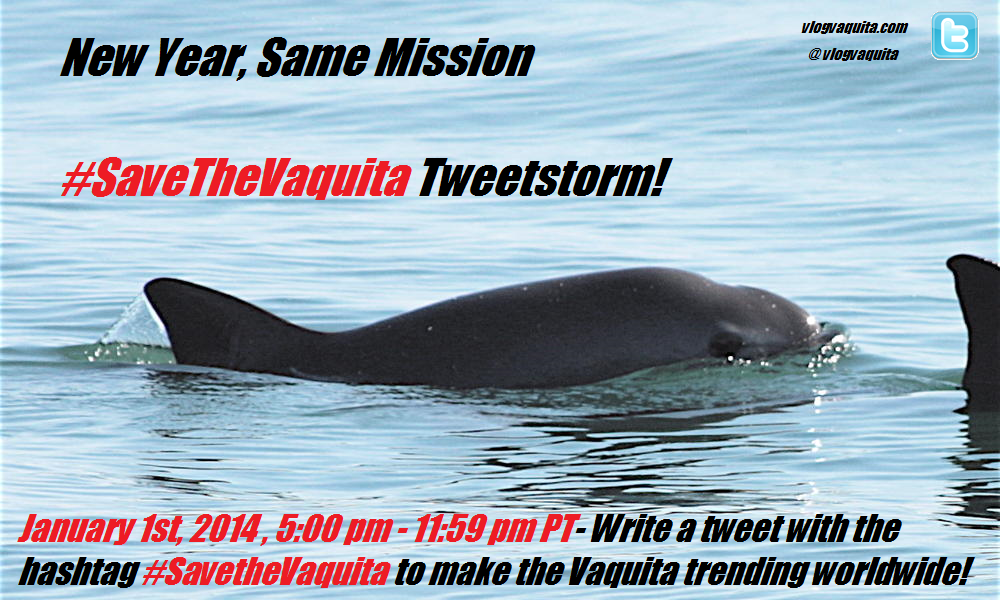
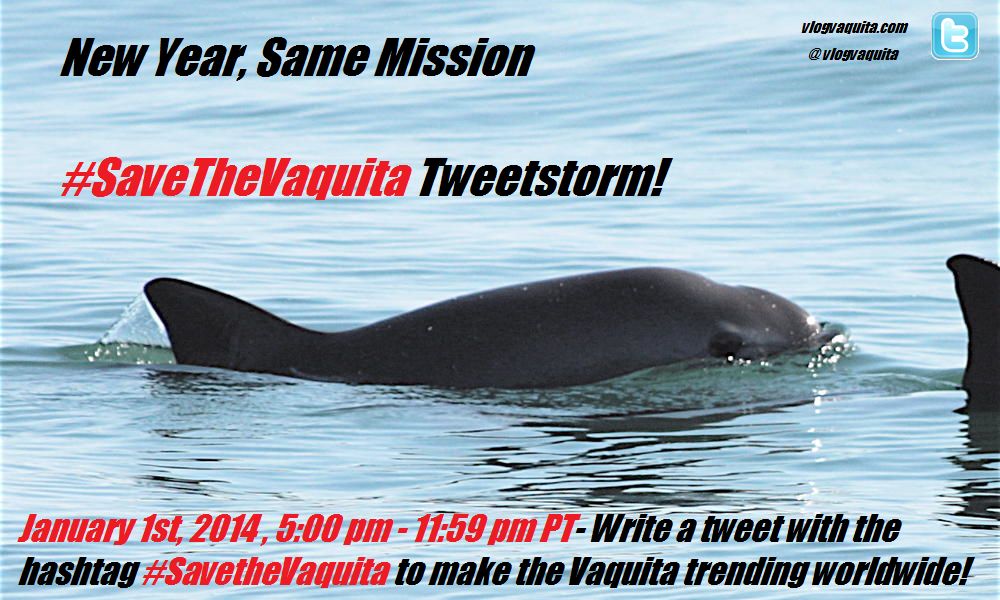
Drop what you are doing and get on Twitter immediately! The #SaveTheVaquita Tweerstorm starts NOW!
Tweet the hashtag #SaveTheVaquita to make it trending worldwide! You can read more about it here: https://vlogvaquita.com/2013/12/18/savethevaquita-tweetstorm/. Also, if you would like, you can direct the tweets to celebrities by adding their @usernames (and mine, @vlogvaquita) in the tweet in addition to #SaveTheVaquita.
Find your time zone below to see when the Tweetstorm will be ending (sorry if yours is not on here; I only put the most likely time zones for people that would be participating, but your time zone can easily be found online.):
January 1st
5:00 pm – 11:59 pm Pacific Standard Time 6:00 pm – 12:59 am Mountain Standard Time 7:00 pm – 1 :59 am Central Standard Time 8:00 pm – 2:59 am Eastern Standard Time
January 2nd
1:00 am – 7:59 am Coordinated Universal Time 2:00 am – 8:59 am Central European Time 3:00 am – 9:59 am Eastern European Time
I will be posting a summary afterwards and hopefully saying that we made the Vaquita trending! Please tell all of your friends and tweet away!
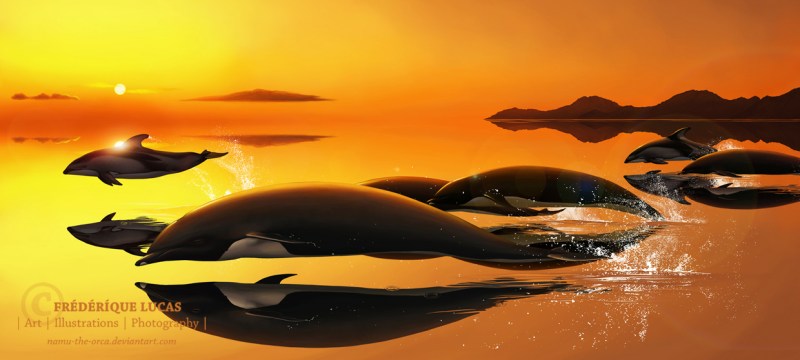
17-year-old Frédérique Lucas from the Netherlands, known on deviantART as Namu the Orca, is the Muskwa Club’s first international member! She is an extremely talented artist with a passion for nature, especially cetaceans. She has agreed to do some Vaquita artwork to help raise awareness for the world’s most endangered marine mammal, so keep an eye out for some incredible Vaquita paintings in the near future!
The Muskwa Club’s newest project is: Viva Vaquita!—The Musical! Here is an article about it from Muskwa’s latest newsletter:
“Muskwa’s latest harebrained scheme continued to take shape this month. Viva Vaquita!—The Musical is already gathering widespread support amongst the South Bay and Peninsula theater communities.
The full-length musical will follow the basic plot line of Muskwa’s YouTube serials while injecting lively musical numbers in a Baja California setting.
Muskwa held the first development meeting on December 12 at Peninsula High. President William Whittenbury and local theater veteran Ashley Trutanich discussed the various aspects of musical production, including costs, sets, and necessary personnel. Muskwa’s musical will be original, so the organization will be able to avoid the crippling expenses often incurred by rights purchases.
In addition, Muskwan Hannah Hilden and noted Peninsula newscaster Natalie Edelstein have agreed to join the cast. Many others have also expressed interest. Local parent and talented artist Nancy Parsons has agreed to paint the sets, noting that she has always wanted to paint underwater backdrops.
Ms. Parsons is known for her beautiful sets for the Point Vicente Elementary Variety Shows, which formed a be-loved part of many Muskwans’ childhoods.
A tentative timetable would see the musical continue development for the duration of the school year, followed by performances in the summer. All profits will go directly to Vaquita charities.
¡Viva Vaquita! has also given us the go-ahead to use their name for the show, so it will be officially titled Viva Vaquita!—The Musical. Go Muskwa!”
It has been a spectacular year for the Vaquita and me. V-log got over 6,200 views from 68 countries in 2013, which is that many more people learning about the Vaquita. Check out this awesome report of this year on V-log, created by WordPress and with cool graphics: Click here to see the complete report.
I got some great art supplies for Christmas, and I started a Vaquita painting that should be finished within the next few weeks. In addition, I have plans to create prints and sell an original canvas painting, so stay tuned!
It’s official! International (yes, International) Save the Vaquita Day 2014 is on July 12th! This year promises to have more, better, and bigger venues than ever. Look out for an ISTVD 2014 logo in the very near future, as well as official updates on the event as venues are confirmed. Here is a wonderful picture by Uko Gorter. Let’s make 2014 the “Year of the Vaquita”!
I know it took a while, but I finally have accounts on every social network that makes sense for the Vaquita! Please take a few minutes to follow and explore all of my pages, so you will have non-stop Vaquita action in your feeds! The buttons below are also in the sidebar:
I strongly believe that the best way to help the Vaquita is to promote sustainable seafood (and promote the Vaquita as you are doing it). As Barbara Taylor said in this article, “Fishermen are more likely to convert to Vaquita-friendly fishing gear if there is market incentive to do so.”
What is sustainable fishing in terms of the Vaquita? I think of it in 3 levels; Worst: Gillnet-caught from Vaquita’s range, Good: Anything else, and Best: Vaquita-friendly trawl from the Vaquita’s range. The reason this is the best is because not only are you not supporting gillnets, you are supporting their ‘rival,’ giving them “market incentive to convert to Vaquita-friendly fishing gear.” Of course, you generally don’t just find Vaquita-friendly shrimp in the grocery store, except for maybe very close to the Vaquita’s range, and even if you do, how do you know it is actually Vaquita-safe? So with this in mind, how are you supposed to support Vaquita-friendly shrimp if you can’t find any? The answer is shrimp festivals:
“WWF Mexico, with funds from the US Marine Mammal Commission and several private foundations are planning a series of events to promote Vaquita-safe seafood. The hope is that this will do for Vaquita what ‘dolphin-safe’ labeling on cans of tuna did for millions of dolphins in the eastern Pacific. These events will feature top chefs serving Vaquita-safe shrimp alongside Vaquita wine. The idea is to connect the fishermen who are sustainably harvesting seafood with outlets that cater to conscientious consumers, and rewarding those fishermen with a bit higher price for their value-added product. The events will need planning, labor, and folks to enjoy the food.”
— Barbara Taylor
These events are incredibly important ways to help the Vaquita, and are completely accessible to the general public. The amazing group San Felipe Pescados y Mariscos recently had one of these events in Mexico. This group is doing exactly what needs to be done for the Vaquita: monitor and promote sustainable seafood from the Upper Gulf of California, including Vaquita-friendly labeling. If you can, please attend these kinds of events, show the fishermen that we do appreciate their efforts to save the Vaquita, and enjoy some of the best shrimp there is.
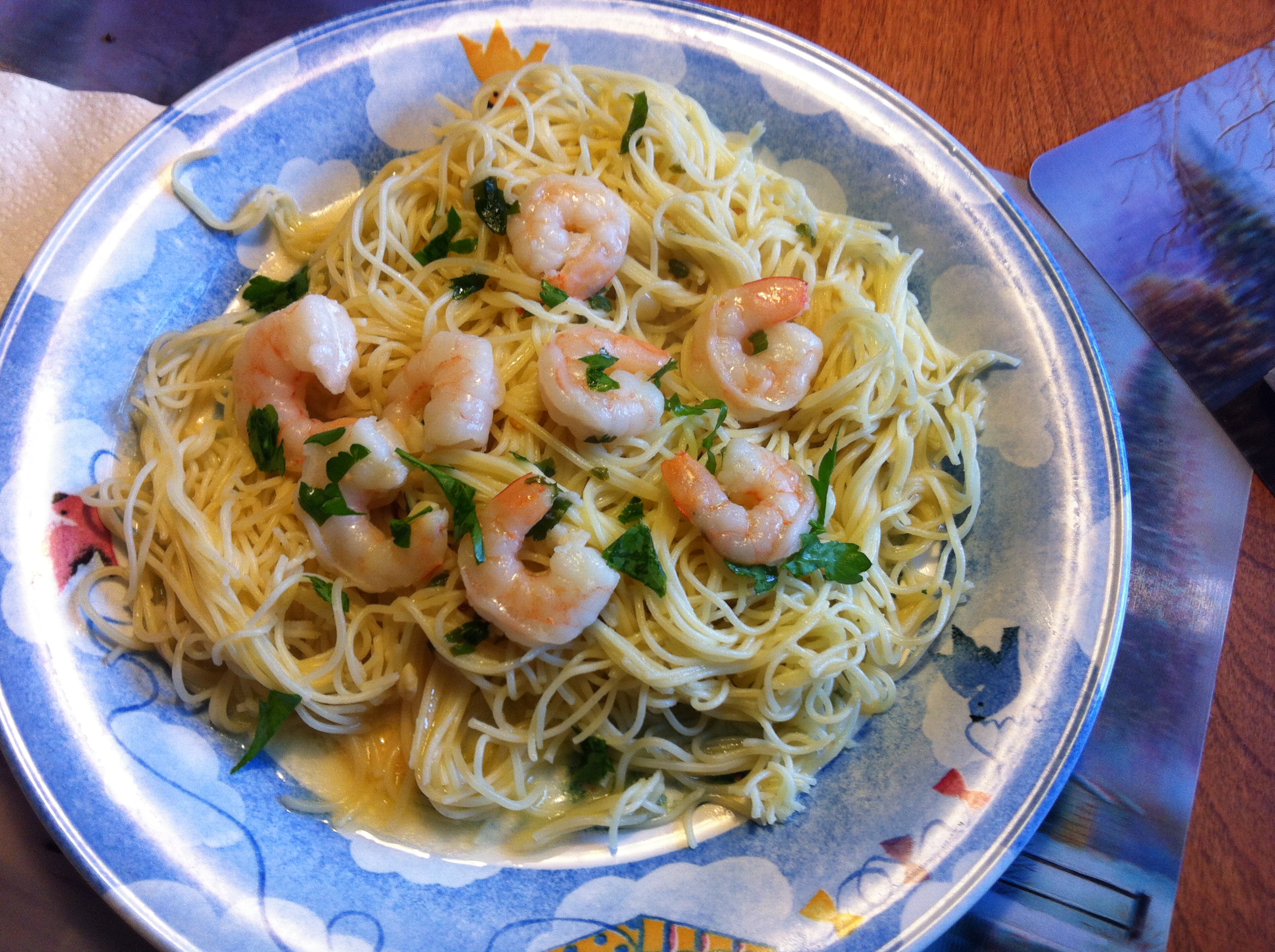
But what if you have my problem: location? There are still ways to support sustainable fishing without visiting a Vaquita-friendly shrimp festival near the Vaquita. The best is to make your own Vaquita-friendly seafood dish (remember my list above; if it says wild-caught in Mexico, don’t risk it. Though it could be Vaquita-safe, there is a higher chance it was gillnet-caught). Create your own recipe, or pick any of the endless dishes online or in cookbooks. Use Seafood Watch (or their great app) as your guide to make the right choices for your meal’s ingredients. Once you finish making your delicious dish, please send some pictures of it to me at gl.tamarin123@gmail.com so I can spread it around the Vaquita community! Please, share this with your friends so we can make this a really big movement!
As far as I know, there are no Vaquita carvings on the planet. Until today. It may have taken more than 22 hours over the period of a week, but my dad finally finished carving the first wooden Vaquita. It all started with a 2×4 from our garage, which I drew the outline of a Vaquita on. Next, my dad used a jigsaw to cut out the general outline, then with a file and carving knife he slowly but surely created the form of a porpoise. After a lot of muscle cramps and sandpaper, he finally finished the carving. Lastly he painted it with many layers of black, gray, and white, taking about 5 hours. I just want to thank my dad for taking so much time on this beautiful carving. Below is a timeline of the finishing processes.
I remember when I was a little boy
first learning about the Vaquita.
I was filled with wonder and determination…
Determination to keep them on this planet.
I donated my Christmas money;
I didn’t get souvenirs when the rest of my family did,
so I could donate even more.
I told everyone I knew,
and told them to do the same.
I even started a Vaquita club at my school to raise money.
I emailed the experts as often as I could,
and read every book and website with the word, “Vaquita.”
I don’t exactly remember what I thought was going to happen to the species,
but I know what I wanted to happen.
That was around the time Chris Johnson’s movie came out,
and I loved it.
But I was also scared…
Scared we might lose the Vaquita forever.
Thinking back upon these things,
I wasn’t doing very much.
But I loved doing it.
Then came V-log.
I still remember coming up with the name,
“A vlog is a video-blog, and Vaquita starts with V, so it could be a Vaquita-blog!”
I was 11 at the time, so I wasn’t the best with websites.
My first post was,
“Vaquita is Spanish for ‘little cow.'”
I became obsessed with learning and writing about the Vaquita,
so I started a book on it.
When I finished writing the book,
I kind of stopped for a little while.
But then my passion was rekindled by art.
I learned that I love to draw, especially Vaquitas.
I began illustrating my book.
And then, on one fateful March morning,
I received a comment.
It was from William Whittenbury.
He told me all about his club,
The Muskwa Club.
My life changed dramatically on that day.
Together, we have accomplished so much.
Videos, tables, my book’s publishing,
and National Save the Vaquita Day.
This event coincided with the Official Norm law,
and this summer was one of utter awesomeness for the Vaquita,
and me.
I am learning the ways of a businessman, conservationist, and artist.
Or some combination of the three…
Muskwa and I may be getting some pretty crazy ideas,
but hey, they are working.
And there has never been a more exciting time in the world of the Vaquita.
Have you ever heard of a Tweetstorm? “A Tweet-what?” you may say. Well, let me enlighten you. A Tweetstorm is a concerted effort on Twitter to get as many people as possible to all tweet the same hashtag during a small time frame in order to give that hashtag extreme popularity, landing it on the ‘Trending Topics’ chart.
The Muskwa Club and I are organizing a Tweetstorm for #SaveTheVaquita on New Year’s Day, January 1st, 2014 from 5:00 pm to 11:59 pm Pacific Time (8:00 pm to 2:59 am ET). During this time, we would like for everyone to tweet about the critically endangered Vaquita using the hashtag #SaveTheVaquita. Also, you can include some eco-conscious celebrities in the tweets, like the incredible @LeoDiCaprio or my favorite singer Moby (@thelittleidiot) so they catch all of this Vaquita buzz.
A Tweetstorm is similar to a petition, but interactive and with more immediate results and potentially a much wider audience. A great example is the Tweetstorm for #SOSMauisDolphins, which garnered almost 12,000 tweets, landing at number 5 on the ‘Trending Topics’ chart, ahead of Beyoncé and Lady Gaga. If we only get a fraction of the tweets that they did, ours can still be considered a success. My goal is 1,000 tweets, but goals are meant to be exceeded.
“Ugh, this social media stuff isn’t for me,” you could be saying right about now. Even if you are a firm believer that social media is only for teenagers and balk at the thought of yourself tweeting, the least you could do is email the flyer below to your friends. But to all you tech-savvy people out there (basically everyone that is reading this), please participate. I would not be nagging about this so much if I didn’t think it was one of the best ways to help the Vaquita. So mark it on your calendars, check out this countdown a few times to remind you, share the flyer increasingly frequently, and get your tweeting muscles ready! If you have been on the border between getting a Twitter account or not, please get one, even if you delete it after the Storm. Thanks so much from the Vaquita!
And don’t forget to follow me (sidebar under ‘Stay Connected’)!
As the year draws to a close, WWF takes a look back on the wonderful year of 2013 in their “15 WWF Success Stories of 2013.” Of course, the biggest Vaquita news in recent memory took place this June in the form of the Official Norm law, a new regulation that guarantees that all shrimp gillnets will be phased into Vaquita-safe trawls within the next 3 years! The Vaquita is featured at number 6 on the list because it was WWF’s petition (which garnered over 38,000 signatures from 127 countries) that caused the law in the first place. We cannot give enough thanks to WWF and everyone else that has helped the Vaquita so far in its eventful, 55-year history with us (the Vaquita was discovered in 1958). Let’s have a toast to a great 2014 for the Vaquita!
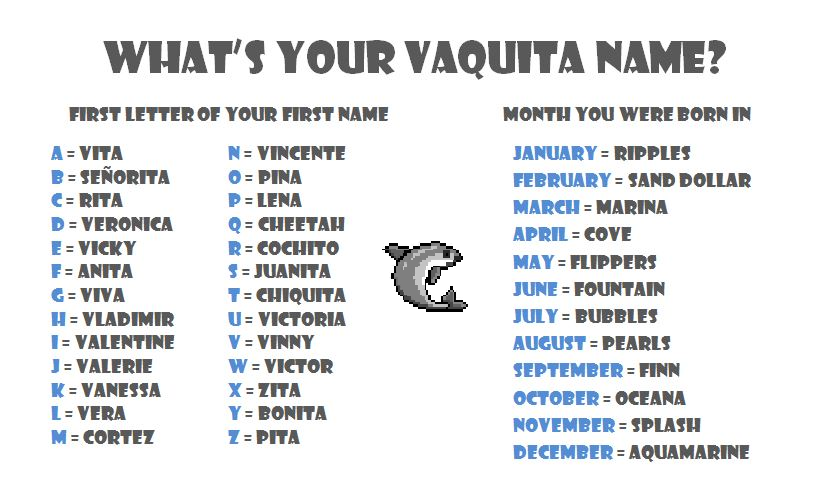
My sister and I came up with a fun holiday activity to find out your Vaquita name! For example, my name is Aidan and I was born in March, so my Vaquita name would be, “Vita Marina.” Have fun and please share!
“We do not learn from experience…we learn from reflecting on experience.”
― John Dewey
Lately I have been thinking a lot about saving the Vaquita…I mean really saving the Vaquita, not just blurting out words and ideas without even fully processing what we are saying. Saving a species has become such a widely used term that we sometimes forget to dig all the way down to the roots of the problem. As the quote above by American philosopher John Dewey states, we need to reflect on our experiences to learn something. In this case, our experiences would be conservation success and failure stories. I decided to look for patterns in the successful species recoveries, as well as in the ones that were not so lucky, to determine what can and should really be done to save the Vaquita.
This article (please read it now) was perfect for this type of research. It is a list of the “top 10 conservation successes and failures,” from 2006. The date does not really matter here, because information about something that happened in, say, 2000 will not change between 2006 and 2013, similar to a history textbook. Here are the successes from the list:
Reforestation of China The American Bison Southern White Rhino Wildlife Reserves Cover 10% of the Earth’s Land
Golden Lion Tamarin Monkey
So what do all of these success stories have in common? The answer is we actually did something. We tried. Scientists started captive breeding programs. Conservationists created protected areas. We made sure we protected the species with every last ounce of energy we could. A captive breeding program unfortunately could not work for the Vaquita because they don’t survive in captivity, and even if they did, they would be virtually impossible to capture in the first place. And don’t even get me started on the whole SeaWorld issue (I am getting Blackfish for Christmas). Our main goal to help the Vaquita should be to really try, and I don’t just mean conservationists. Everyone, fishermen, public figures, governments, and the citizens of the world need to band together to save a species that cannot save itself. We already have multiple protected areas for the Vaquita, which is a great start, but as I’ve said many times before, the areas do not completely cover the porpoise’s full range. And enforcement on these protected areas is not as strong as it needs to be, which is hopefully changing. Fortunately, animals with smaller populations and more dangerous habitats than the Vaquita have come back from the brink of extinction, so it is still not too late.
Now let’s look at the failures to learn what to avoid in our mission to save the Vaquita:
Destruction of the Amazonian Rainforest Saiga Antelope Northern White Rhino Worldwide Amphibian Declines Orangutan
So what did we do differently? As you might expect, the exact opposite of what we did in the successes: absolutely nothing. As with basically every endangered species on the planet, these animals are being destroyed by us humans, much like the Vaquita is. Yet we did not take the responsibility of helping our innocent victims. Many of these failures are due to a lack of understanding or control over the threat. Luckily, the Vaquita is in a perfect habitat with only one problem: accidental entanglement in gillnets. Bycatch is a much easier-to-deal-with threat than poaching or trapping because it isn’t even intentional, and climate change because it is a direct threat. With the right teamwork, the Vaquita can definitely be saved.
So in recap, we learned that we can save the Vaquita by, well, saving it. We mustn’t sit around and hope it survives.
We need to take action now, before the Vaquita itself becomes an experience to reflect upon.
Please don’t forget to think about the Vaquita over the holidays. I know it is hard to worry about a porpoise while you are chowing down on a warm apple pie, but the little things really do make a huge difference. For example, you can Adopt-a-Vaquita for someone as a gift, or donate a few dollars from a Christmas card to ¡Viva Vaquita!. Maybe make a Vaquita-conscious holiday meal, buy a beautiful Vaquita item from ¡Viva Vaquita!’s gift store (with the new Memuco collection), or easiest of all, write a Facebook post or Tweet about everyone’s favorite critically endangered porpoise. And please, show us what you did! Leave a comment or shoot me an email at gl.tamarin123@gmail.com saying the wonderful things you came up with this holiday season!




 V-log
V-log 