Beyond the surface

—with special guest co-author, VIVA Vaquita’s Cheryl Butner

Once you break through the surface, the Vaquita’s situation is extremely dynamic and complex. From afar, it may seem like a simple ‘problem and solution’ scenario. It is anything but.

There are a few realistic ways that the Vaquita can be saved. One is if the fishermen stop fishing and take up different careers. The other is if they continue to fish but with Vaquita-friendly fishing gear. Both haves positives and negatives, and both will be difficult to do.

There aren’t many viable career options for the people of the Gulf. You could own a shop, restaurant, or hotel, but these businesses are not going to be able to sustain a large family due to a lack of tourism. However, there is one form of tourism that could be a game-changer: ecotourism. Ecotourism is defined as “responsible travel to natural areas that conserves the environment and improves the well-being of local people.” I have received many questions about this, and some people even said they were going on one of these tours to search for Vaquitas. I am filled with hope by seeing how many people would be willing to look for the Vaquita to support the fishermen who have switched careers from exploiter to explorer, but it is unfortunately not that simple. Cheryl Butner takes a closer look:

“A permit from the Mexican government is required to enter the Vaquita refuge, generally for research or scientific purposes. It is important that tourists realize that looking for Vaquita is not like going on a couple-hour whale watch trip. The areas where Vaquita have been spotted are not close to shore, Rocas Consag, which is the “center” of the Vaquita Refuge is something like 17 miles from San Felipe, as I recall it took us 2.5+ hours just to get out to the reserve one way from San Felipe, but our boat was pretty slow. Once you are out there, chances are incredibly slim that you will see Vaquita since they are so shy of boats and so small. It is was very common for fishermen to tell me that in the 20-30-40 years they have been fishing in the area they’ve never seen a Vaquita. In theory tourists could hire a boat to cruise around the outside of the refuge, but as long as they are aware it would be more to enjoy the Sea of Cortez and maybe see some whales, sea lions, rays, but not to get their hopes up about seeing Vaquita.  The Upper Gulf of California is a fantastic place to visit with its beautiful beaches and deserts, world-famous fishing, a wide variety of watersports, wonderful people, and incredible food (but don’t order seafood caught with gillnets!).  The best ways tourists can help Vaquita are (1) travel to this region and encourage their friends and family to travel here as well, (2) talk to everyone they meet and tell them they know about the Vaquita and they want to protect it from extinction, and (3) support the businesses that support the Vaquita.

But if travelers still want to attempt to see a Vaquita, they should go to San Felipe. Puerto Peñasco is pretty far from the refuge, unless they wanted to do a multi-day boat trip. As far as size of these communities, Puerto Peñasco is the biggest and has the most services for tourists and locals. There are fancy resorts, tour companies, everything you could want. San Felipe is smaller than Puerto Peñasco but still has the main things tourists are looking for. El Golfo de Santa Clara is very small, basically a fishing village with few tourist amenities. Most tourists that go there camp on the beach in their RVs and there are a few restaurants and a couple small hotels. I’ve heard that drug smuggling is pretty prevalent in Santa Clara, although I’m sure it’s well hidden from the few tourists that go there. I was there for a day so I wasn’t there long enough to make many observations.

Tourism in that region is actually really interesting. With the American tourists being scared away for several years now because of what our media is telling them, there have been the obvious really bad consequences, like any businesses related to tourism are struggling to stay open, if they haven’t closed already. But there has been a positive side to this too, in my opinion. As an example, I’ve been going to Tijuana for over 20 years. Before all the drug wars in Mexico and economy crashing in the US, it was pretty much like you would see in the movies, a lot of gringos going down there to drink, party, pick up prostitutes, get drugs (legal and illegal), and little kids on the streets begging for money. Now that the American tourists are pretty much gone, Tijuana has really cleaned up and is actually starting to be known as a cultural and food capital. Many newspapers, blogs, etc. have written about how Tijuana is a new gourmet food destination and even some of the shows on the Food Network and Travel Channel have featured Tijuana. Plus the economy in other parts of Mexico (particularly in the big cities) was not as hard-hit as the US was, so the numbers of Mexicans traveling and vacationing in their own country is way up, which is really great. So you see some of this in the Upper Gulf towns as well, especially with more Mexicans vacationing there now than there used to be. Hopefully the number of Mexican tourists will continue to grow to help make up for the drastically reduced numbers of American tourists, which will probably stay really low for a long time.

All of this makes me wonder if, in cities like Tijuana anyway, the American tourists had more of a negative influence than a positive one. Hopefully after Mexico gets control over the drug problems and is able to overcome this unwarranted stigma of being a dangerous country, it will be able to reinvent its image and get away from being known by Americans as a wild party destination, because the country has so many diverse and incredible experiences to offer tourists. It’s already starting in Tijuana, so hopefully the positive changes will continue.

CEDO’s website has a several year old list of businesses that switched from gillnet fishing during the buy-out program. I’m not sure how many of them are still operating.  From what I’ve heard the program didn’t go well because the American tourists stopped coming right around the time a lot of these businesses were just starting out, so they pretty much lost everything. I’ve even heard that some of them may have gone back to fishing to be able to support themselves and their families, if so that would mean they are fishing illegally since many gave up their permits in the buy-out,.  And who could really blame them really if they did. They thought they were doing the right thing and ended up getting burned. It was nobody’s fault, nobody could have foreseen the tourists completely disappearing in such a short period of time.  It’s important to remember that without the fishermen’s support, saving the Vaquita will be incredibly difficult, if not impossible.  That is why everyone – the Mexican government, the local communities, the NGOs, and anyone who cares about the Vaquita – needs to work together in order to prevent its extinction.”

Cheryl and I agree that the more feasible of the two options I mentioned earlier is the switch-out, where the fishermen use alternative fishing gear. There already is the Official Norm law, which is phasing out all shrimp gillnets with Vaquita-safe trawls within the next 3 years, starting in 2013. This is, as Lorenzo Rojas-Bracho put it, “pretty damned good news.”

There is still the gaping hole of finfishing, which could be even more dangerous to the Vaquita than shrimping. The development of effective, Vaquita-safe finfish nets is absolutely mandatory within the next few years if we hope to save the desert porpoise.

So, where does this leave us?

The average person will never see a Vaquita in their lifetime. They are one of the rarest and most secretive animals on Earth. And realistically, you cannot help with things like the development of new fishing gear and assisting fishermen with career changes. But there are still ways that you can make a real difference for the Vaquita. Spreading the word to people that you think could help such as celebrities and animal lovers (or both) is a great way to start (the Post-a-day Challenge is still going on!). Next you could cook for the Vaquita, or buy a VIVA Vaquita t-shirt. Also, my book can teach you a lot more about the Vaquita, while its profits go directly to Vaquita causes.

The important thing is that you are doing something. There are endless ways to help the Vaquita, so go ahead, make a marine mammal proud today.
World Wildlife Day

Today, March 3rd, is World Wildlife Day. Today is the day to take the time to appreciate our planet’s incredible creatures. In recent years, we have been depleting our world’s natural resources, especially our amazing animals. The Vaquita is one of these animals. We cannot afford to lose it in the fight against extinction, and there are many ways to help the Vaquita today.

One way is to purchase an awesome Beach Bar Radio ¡VIVA Vaquita! t-shirt, where all proceeds go to the Vaquita! The campaign ends in 28 days and their goal is 50 t-shirts. I will be getting one for my birthday!

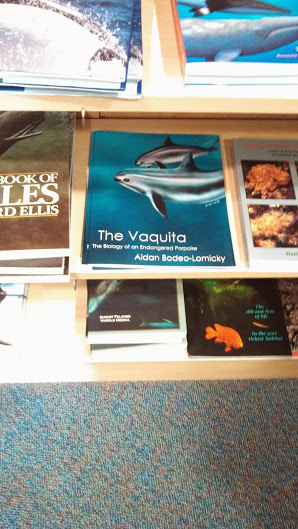
You can also purchase my book, The Vaquita: The Biology of an Endangered Porpoise, for only, $12.95, again with all profits going to Vaquita charities.

The Vaquita: The Biology of an Endangered Porpoise

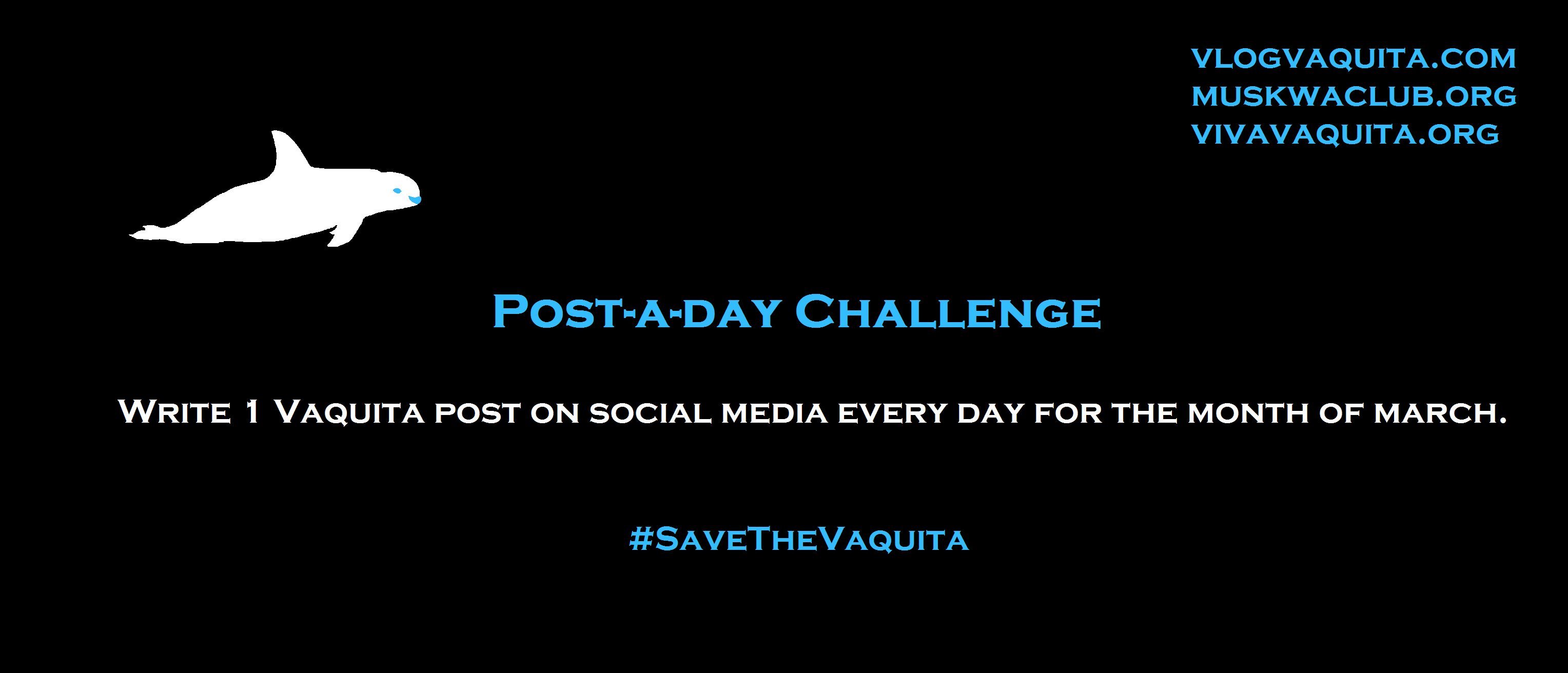
An even easier and free way to help the Vaquita is to participate in the Post-a-day Challenge! Simply write at least 1 post on social media every day for the entire month of March. #SaveTheVaquita

Post-a-day Challenge

Of course, there are many other ways to help the Vaquita, such as cooking to save the Vaquita, or just by telling your neighbors about the world’s most endangered marine mammal. No matter how big or small your contribution is, just know that the Vaquita greatly appreciates it!

Post-a-day Challenge

Please participate in our newest campaign: the Vaquita “Post-a-day Challenge!” We are challenging you to write at least one Vaquita post on social media every day for the entire month of March (already starting tomorrow!). Please let us know if you are participating (via comments, posts, or tweets), and share the banner below to spread the word! Also, if you read this after March 1st, please still participate. It is much better late than never! #SaveTheVaquita!

Post-a-day Challenge

In other news, I am now part of The Dodo, an amazing animal website, where I will occasionally be posting some Vaquita articles: https://www.thedodo.com/community/vlogvaquita.

Also, please add this International Save the Vaquita Day PicBadge to your Facebook profile picture!

William Whittenbury sent me this great picture of my books in the Cabrillo Marine Aquarium’s gift shop! Please purchase one as a donation to multiple Vaquita charities, such as ¡VIVA Vaquita! and the Muskwa Club.

Book on sale

Also, keep an eye out on Paws on Controls, a really neat activism website that will be featuring an article about the Vaquita and V-log in the near future.

Folktale

This is a folktale I wrote for one of my Literature classes. Please enjoy:

“SOME TIME AGO, in a time of great poverty, the people of El Golfo de Santa Clara, Mexico were in desperate need of money. Every day, the children would go out onto the dirt roads and search for coins, and the mothers would take off time from maintaining their homes to open fruit and vegetable stands in the village. But even with all of this, they still did not have enough money.

So the men had to go out on their little fishing boats with their nets to catch fish or shrimp. Slowly, the village became more and more wealthy. They were catching so many shrimp that they couldn’t even sell all of them! The entire village ate seafood every day, and times had never been better. The town started building bigger houses, and everyone sang and danced at night.

Occasionally, however, they would catch something in their nets called a Vaquita, a magical porpoise. It was so rare that most villagers did not even believe it existed. Seeing one was considered to be a good omen, but catching one was not. If you killed a Vaquita, you would be cursed with bad luck for a week. The fishermen could not let this risk keep them from fishing, however.

One day, a man caught a Vaquita. Afraid of getting bad luck, he threw the dead porpoise back into the water. Later that day, he was walking down the street and tripped over a rock. He broke both his wrists, rendering him useless as a fisherman for a long time. He was devastated, but in the back of his mind he knew that it was from catching that poor Vaquita.

A different man also caught a Vaquita, but he kept it onboard to bring it home to sell for meat. He was afraid that he would be cursed, but a few days went by without anything happening. Then one morning, when he went outside, he was shocked to see that all the houses were tiny again, all the tourists and buyers were gone, and the children were back in the streets picking up coins. The women were once more solemnly selling fruit and vegetables on the street corners. He saw a man who had broken wrists.

“Hello, sir. What happened to your wrists?”

“I caught a Vaquita, and on the same day I fell and broke my wrists.”

“I caught a Vaquita too, and now the entire village is poor again,” the man said. He knew that it was his fault.

But then the men got an idea. They went out in a boat to look for a Vaquita. After a while, they saw one of the beautiful creatures. It had its baby with it, which reminded the men of their families. They realized that the Vaquita deserved to live just as much as they did. With this realization, they returned to their village to share the news of the magical encounter. When they arrived, they were shocked by what they saw.

Everybody was dancing in the streets again. Their houses were bigger than ever. There were tables of rich meats, fruits, vegetables, and grains everywhere, and the entire village was cheering.

“God has given us back our wealth! Praise the Lord!”

The two men looked at each other. They knew that their encounter had caused this.

“Attention everybody! Today we saw a Vaquita with its baby. They were not in our net, but free, swimming in the ocean. This is how Vaquitas are meant to be seen. We must stop catching them with our nets. All of Earth’s creatures deserve to live, just like us. We got even more wealth from looking at those Vaquitas then we did when we caught them!”

The entire village went quiet. They all whispered to each other about what they just heard. “If we stop fishing and show people the Vaquita instead, we will be even richer! God wants us to protect His creatures!”

From that day on, the people of El Golfo de Santa Clara showed others the wonderful Vaquita, and they all lived happily ever after.”

¡VIVA Vaquita!

*The Muskwa Club has also accepted their offer: http://vivavaquita.org/aboutus.html!

It all started on August 8th, 2010, when I was 10 years old. At the time, I had a really strong fascination with Sperm Whales. I was looking for a way to symbolically adopt one, which led me to the Save the Whales website. In the top right corner of the page, I noticed a picture of a little gray porpoise that said “Help Save the Vaquita!!! The World’s Most-Endangered Cetacean.” I had heard of the Vaquita before from one of my marine mammal field guides, and I remember loving how they looked. But I had no idea they were endangered. I started to read about this mysterious creature called the Vaquita. Something about it evoked an emotion that I had rarely felt before. A mix of fear, curiosity, vulnerability, sadness, and determination. I could not believe it was so rare, and that is was still decreasing. How could this be happening? I knew that I had to help it.

I scrolled down and clicked on the link to ¡VIVA Vaquita!, where I was captivated even more. I entered this into the contact box, “How much money is usually donated? Is $30 good? And can I learn more about vaquitas? Thanks!” A few days later, I received a package from Dr. Thomas Jefferson, containing a bunch of things to help me learn about the Vaquita, such as some brochures and a magazine that focused on them. I was hooked. A little over a year later, on September 27th, 2011, I started the website that you are reading this post on. I have always been obsessed with ¡VIVA Vaquita! and look up to them like a celebrity, which they are, in my eyes.

They are the world’s leading Vaquita conservation group, and their work is unparalleled in the activism community. That is why their email to me last night completely shocked me. They invited V-log to become an official member of ¡VIVA Vaquita! I hope our new partnership will create some amazing new opportunities, and I will be sure to keep everyone updated. I would like to thank ¡VIVA Vaquita! again for continuous inspiration and for asking me to join their incredible organization!

In other news, the Muskwa Club will have some big announcements coming within the next few months, so stay tuned.

VIVA Vaquita

How to draw a Vaquita

I have been doing a lot of Vaquita artwork recently, so much, in fact, that I have developed a method for drawing this little porpoise. I have created a “How-to-draw a Vaquita” guide for all of you artists out there that are looking to make some Vaquita art. Obviously, this is not a definitive guide, it is just how I draw Vaquitas.

Before anything, you need to figure out exactly what you want the picture to be. You can base your drawing/painting on a photograph, but in this guide I will be drawing a generic Vaquita that can be used for any pose. All I will be using is a pencil and my fingertip.

1. Firstly, you need to draw a rough outline of the body. This needs to be very light. Don’t worry about it not being perfectly smooth yet. Don’t draw any external details, such as stripes or eye-patches. Just the outline. This will take a lot of practice to get right, so don’t give up if you need to erase the outline 10 or more times. A very useful tip is that the mouth is always smiling and pointed directly at the eye, which is slightly above the imaginary horizontal center line of the head.

Step 1

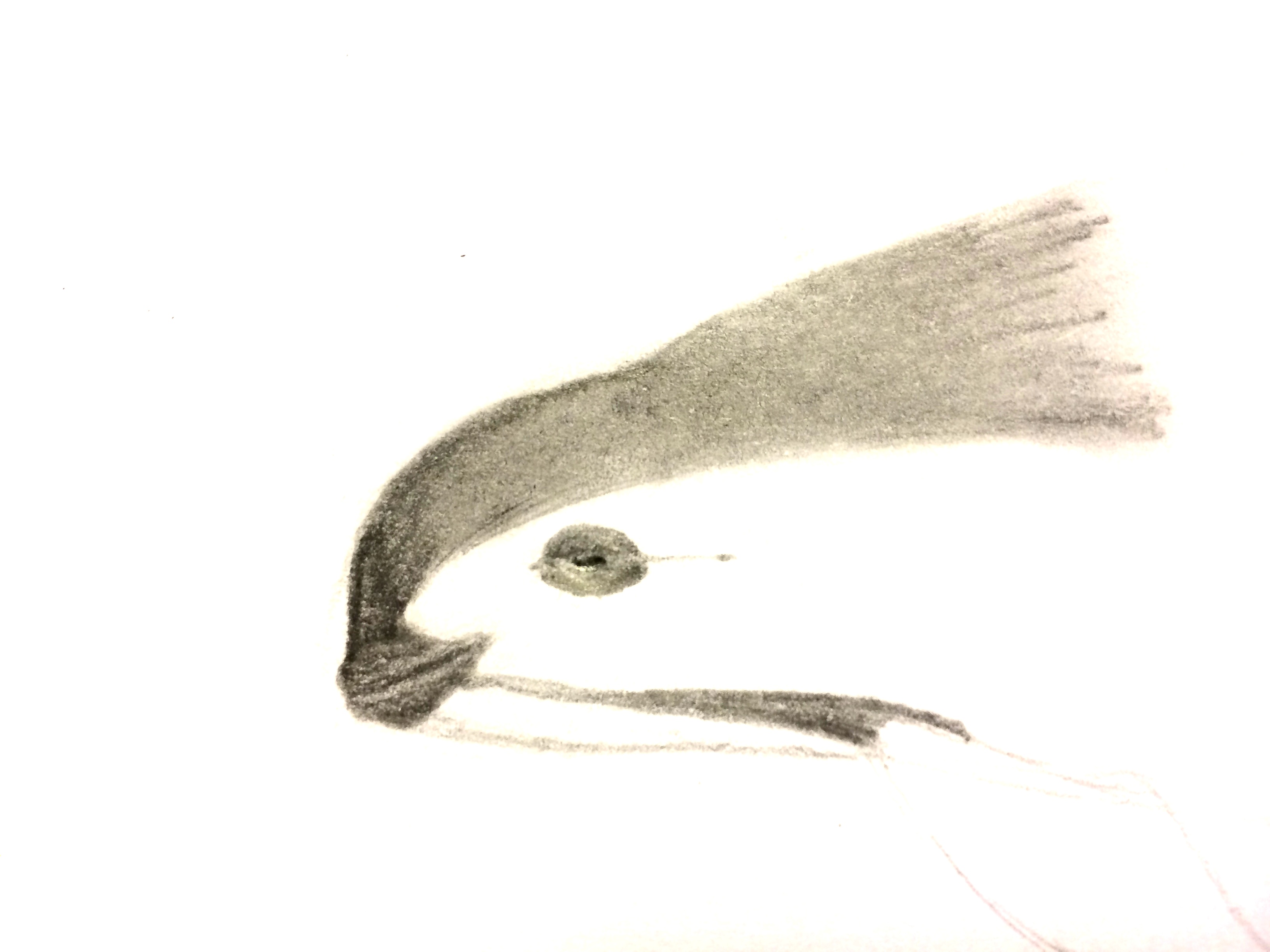
2. Next you will start adding detail. I prefer to start with the face and work towards the tail fluke. It is very useful to look at a bunch of photographs to get a good idea of what their individual body parts look like. The key points on the head are the eye-patch, mouth-patch, chin-to-flipper stripe, and the tiny ear hole, which is commonly forgotten. Also, begin the dark back, which is basically an extension of the mouth-patch.

Step 2

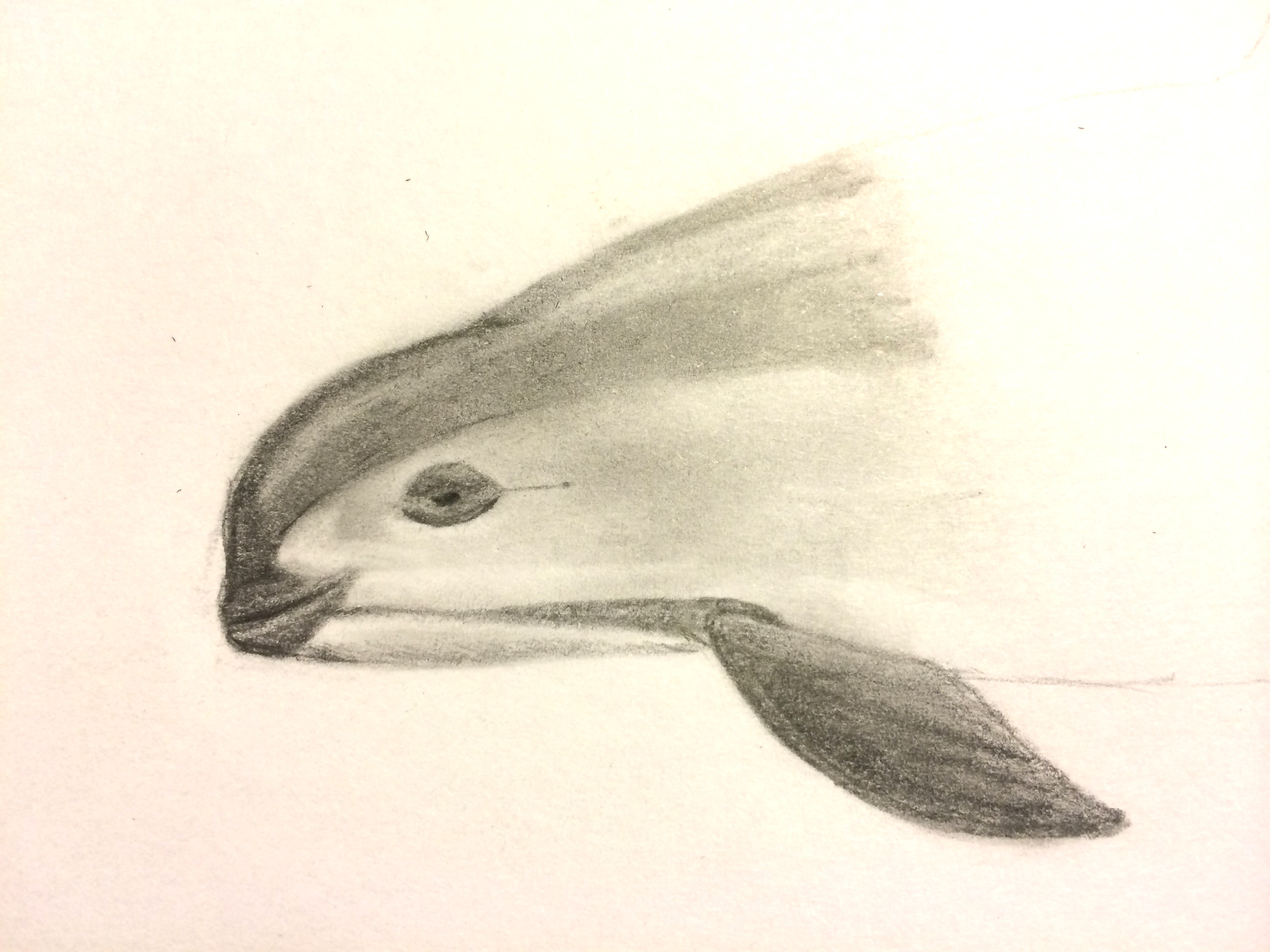
3. Take this time to make sure your pencil is very sharp. Redefine all of the details you already made, especially shadows. When you are coloring the back and flipper, make sure you rub the paper very hard with your fingertip to make the texture smoother. Now you can add the lighter gray to the face simply by rubbing, due to the excess lead on your finger. You can also add shading to the underside of the body with the rubbing technique, and the shine on the back by erasing lightly. You can also use the eraser to add subtle touches to the facial pattern, such as a ring around the eye-patch. Don’t forget to show hints of finger bones in the flipper. It is important that you know where the light source is coming from. In this case, the “sun” is above and to the right of the Vaquita, so I have the dark shading on the opposite sides of the light source (bottom left) of every curve. This is especially noticeable on the flipper.

Step 3

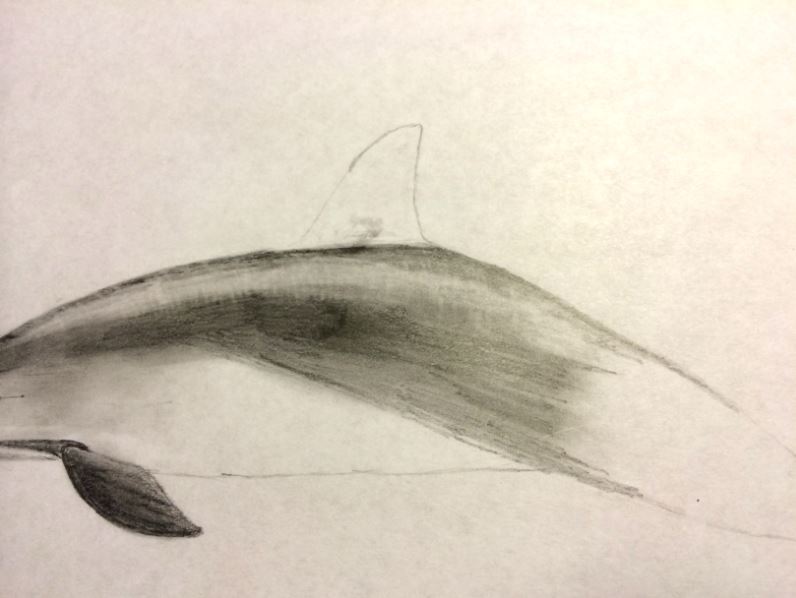
4. Next you need to work on the body. Use the same technique as the head: draw then rub. Make sure you are still looking at some pictures to get an idea of the color pattern. Vaquitas have a dark back, with light gray sides fading to a white belly. Make sure you continue the shine by erasing lightly, as well as drawing subtle muscles. Your fingertip should be pitch black as you are working on this. Next, you can work on the dorsal fin as well as any scars or markings for additional realism.

Step 4

Step 5

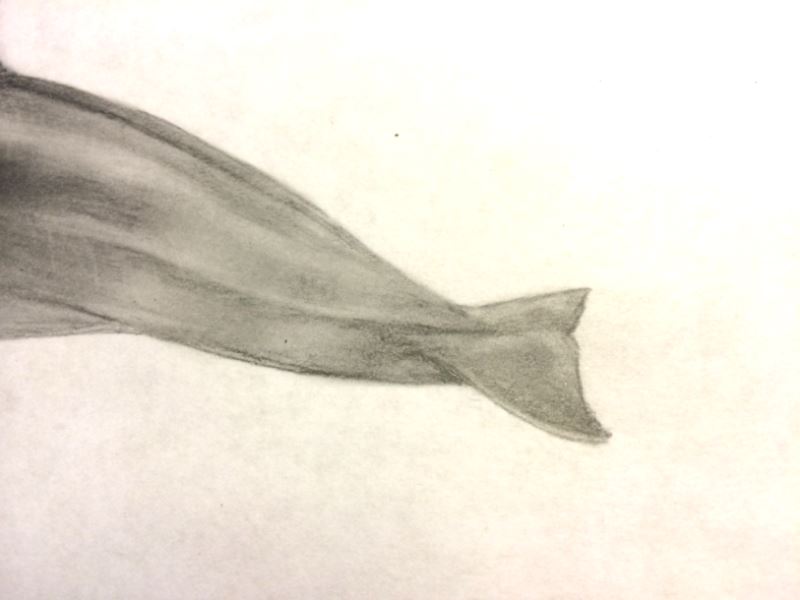
5. The final step is the tail stock and fluke. Pay close attention to the muscles and ridges of the tail stock, because the shading and lighting is crucial to making it seem real and 3-dimensional. There is a ridge along the vertebrae called a dorsal ridge, as well as a caudal keel, which is a ridge on the side of the tail stock connecting to the fluke. The fluke is basically flat, giving it a more uniform color than other body parts. When you are done with this, take a few minutes to overview the entire drawing. Squint, turn it upside down, take a photo of it, or ask someone else what they think; anything to help get a new perspective of the overall work of art. When you feel like you are completely content with your drawing, breathe a sigh of relief: you drew a Vaquita! Obviously your second try will be better than your first, third better than second, and so on, so stay patient. And of course, I would love to see your masterpiece! Please send your drawings to me at gl.tamarin123@gmail.com, as always.

Step 6

Here is my finished piece.

Finished

#SaveTheVaquita Tweetstorm recap

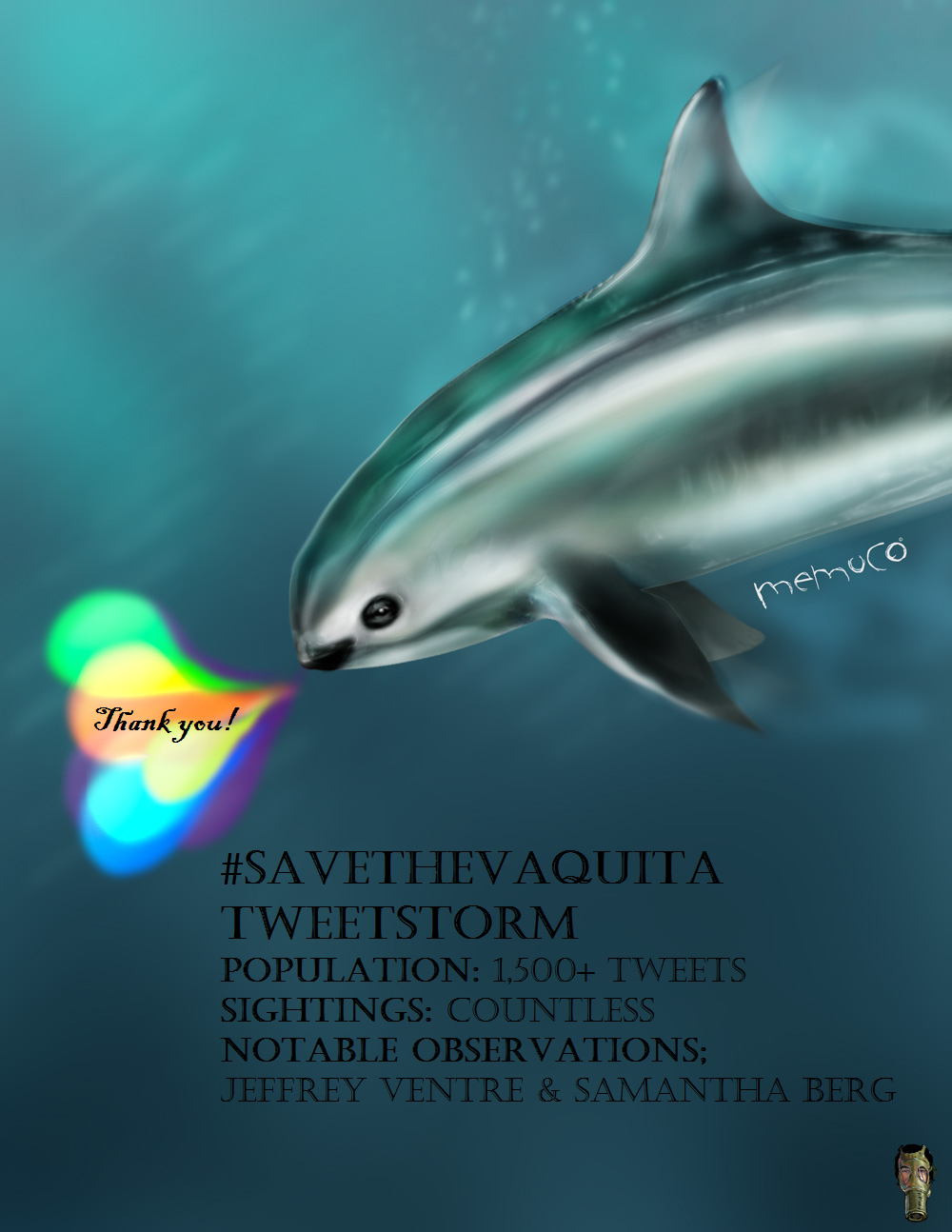
Were you one of the hundreds and hundreds of people who participated in the #SaveTheVaquita Tweetstorm last night? If so, thank you so much, and if not, you can still tweet the hashtag #SaveTheVaquita to help!

The Tweetstorm was an outstanding success! I can’t believe how many people wrote about the Vaquita in one night! We got over 1,500 tweets (not even including retweets) with the hashtag #SaveTheVaquita, and countless more people read those tweets. We were getting about 250 tweets per hour! People are still tweeting as you read this! You can read all of the #SaveTheVaquita tweets here: https://twitter.com/search?q=%23SaveTheVaquita&src=typd&f=realtime.

Seeing as many of the #SaveTheVaquita tweeters have thousands of followers, the viewership was literally exponential. My aunt coincidentally texted me saying that she saw a Vaquita tweet (she knows about it from my book), and little did she know that it was because of a Tweetstorm that I helped create! If my aunt, who had no idea about the Tweetstorm before our conversation, saw a tweet about the Vaquita, who knows how many other people did! Some famous people in the cetacean world joined the storm, such as @jeffrey_ventre and @Sam10k, both former SeaWorld trainers turned anti-captivity, who are in the revolutionary documentary Blackfish.

Unfortunately, the hashtag did not go trending worldwide, though it likely did locally in multiple locations. When I started to type in the hashtag, #SaveTheVaquita was one of the first suggestions, meaning it was very popular last night. I just want to thank everyone who tweeted for the world’s most endangered marine mammal, especially the people who tweeted more than once (you know who you are), because you really made a difference! Muskwa and I are already planning the next Tweetstorm!

Thank You