Here is the Muskwa Club’s official coverage of National Save the Vaquita Day from their monthly newsletter The Phoenix and the Flame. Please enjoy some firsthand accounts of the day and learn a bit more about this wonderful organization.
Tag Archives: Vaquita
The olden days
This weekend I am on vacation in Sandy Hook, New Jersey. While exploring the famous lighthouse, we found a gift shop that contained many ocean-related objects. When I was checking out the books, I was astonished when I found the “Whales and Dolphins Coloring Book” by John Green. I immediately recognized the book (because of my past internet research) as one of the only in the world that contains the Vaquita. This book was published in 1990, before the Vaquita’s appearance was well-known. To give you a feeling of how much we have learned about the Vaquita in the last 20 or so years, here is what the Vaquita’s coloring page looks like:

And here is their example of the Vaquita:
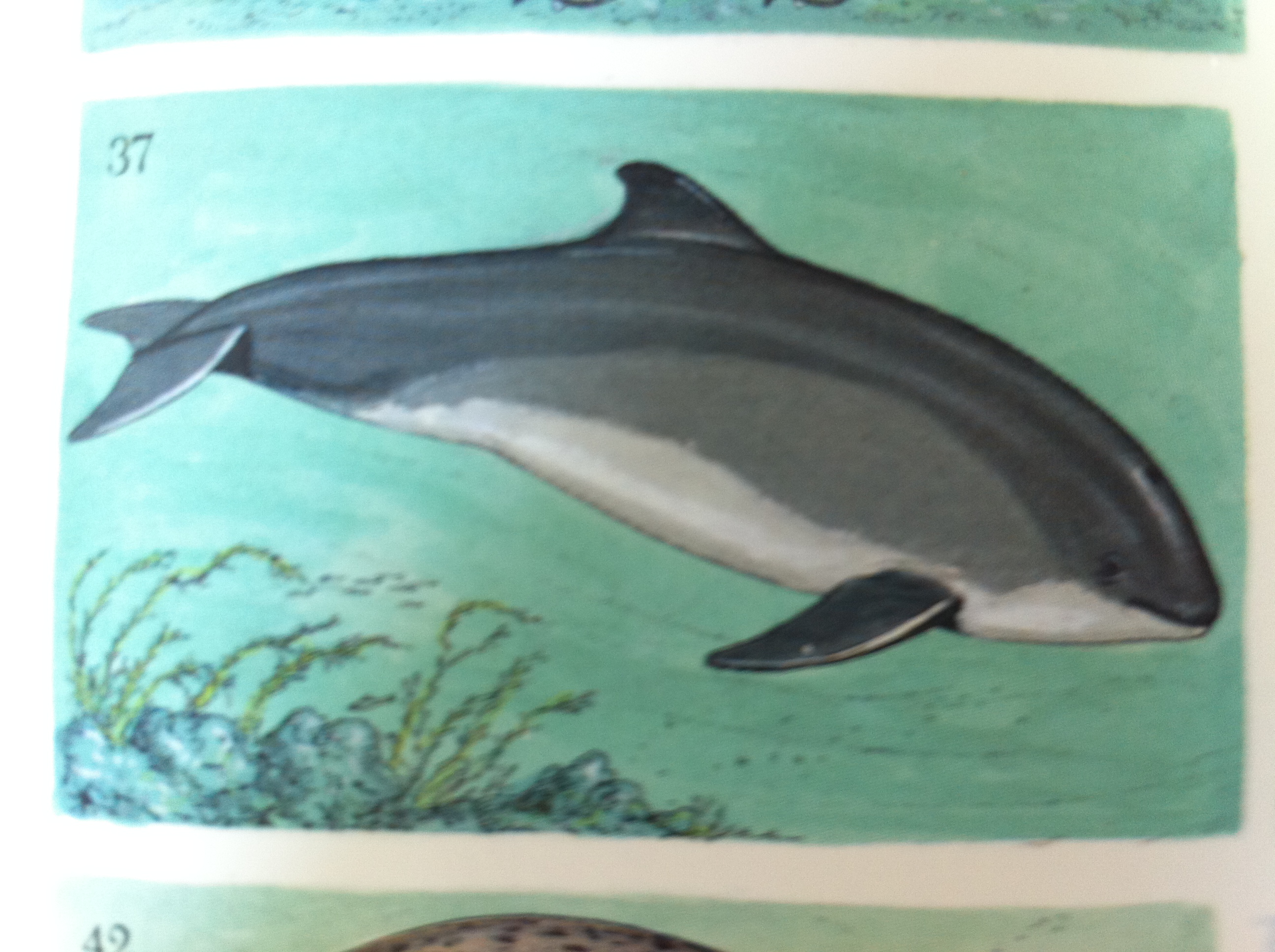
They didn’t even know that the Vaquita had eye- and mouth-patches, as well as the chin-to-flipper stripe and a triangular dorsal fin. The Vaquita was discovered in 1958 from a few skulls, and first seen in 1985. We still have so much to learn, but it will not be possible to learn anything if we lose them now.
It’s not time to let go
Okay, so I found a link to an article in a New York Times blog post. The article, here, by Erik Vance, is on an extremely personal and controversial topic:
Should we let the Vaquita go extinct?
I had to close my eyes and calmy inhale to even make it through the article. The answer is absolutely, positively, no way in the world, not in a million years, no. He says that perhaps we should let the Vaquita go in order to get the fishermen on board with saving other endangered species of the Gulf. I am not sure if/how that would even work, but there is no way that the scientists and conservationists who have worked on saving the Vaquita for their entire careers would just let the Vaquita ‘slip away.’ I am not arguing with the fact that the Vaquita is in a tough situation right now, and that there has been phenomenal effort by the Mexican government to seemingly little avail. I am not arguing with the fact that the Vaquita is a life-changing ‘nuisance’ to the fishermen that they will likely never see in their entire lives, yet they have been very cooperative with NGOs and the government for the most part.
But this is about the big picture. The Vaquita cannot be a canary in a coal mine. It is not an option for us to learn from our mistakes on the Vaquita. We have already lost the Baiji because of human activities. Those beautiful dolphins were sacrificed so we could learn what not to do with an endangered species. The Vaquita is the test. If we can save the Vaquita, we can do anything. Tigers, pandas, rhinos, polar bears, and every other endangered species can benefit from us saving the Vaquita, not letting it go extinct. The Baiji has already filled that role.
It is also about the little picture. The Vaquita simply deserves to live. If you were born before 1958, then the Vaquita was discovered in your lifetime. Now it could go extinct within the next few years. Your life could completely encompass our knowledge of the existence of an entire species. We definitely do not want that. The Vaquita as an animal is extremely unique. We will absolutely never have a species like the Vaquita again if we lose Phocoena sinus.
So the real question is, “Now that we know the Vaquita can’t go extinct, how are we going to save it?” In June, an enormous step was taken by the Mexican government in the form of a new regulation that will phase out all shrimp gillnets to Vaquita-safe trawls within the next 3 years. This is great news, but this doesn’t mean our work here is done. The government still has to pull through with their promise, as well as develop safe trawls for finfish, not just shrimp. For now, you can help the Vaquita by raising awareness, not buying seafood caught in gillnets, and raising money towards the switch-out program. For more details, visit https://vlogvaquita.com/2013/07/14/update-the-big-3/.
So my point is, there is no way we can give up, especially after all this time and effort. This is where we need to explore the limits of human teamwork to save something that’s not a human. The Vaquita has never done anything to us, so why should we accept murdering every last one? This adorable, innocent little porpoise deserves every drop of blood, sweat, and tears we can squeeze out of ourselves. And even if the Vaquita does eventually go extinct, I could not live with myself knowing that we didn’t try our hardest to rescue it.
We need to at least, as my tennis coach would say, go down swinging.
First donation details
A huge thanks to everyone who bought my book in its debut month! I am going to send a check of 25% of my earnings to ¡Viva Vaquita! (like I will for every future month), along with additional money going to other Vaquita causes, like the all-new switch-out charity (see post below for link).
________________________________________________________________
Here are the details of the donation:
Between June 28 and July 30, I sold:
19 books online (15 via https://www.createspace.com/4268018, and 4 via Amazon.com), equaling $117.13
and 21 books in person, equaling $280.00
for a total of $397.13
and an average of $9.93 per book
Total donation to ¡Viva Vaquita!: rounded up to $100
________________________________________________________________
So for my first month of the book, I will be donation $100 to ¡Viva Vaquita!, leaving $297.13 for other organizations and future endeavors of us and the Muskwa Club.
Now it is time to get ready for next month’s donation! If you haven’t already bought the book, or you want more, please purchase as many as you would like from https://www.createspace.com/4268018. Thank you!
Last chance for this month’s donation
If you buy my book before the midnight of tomorrow, August 1, 25% of the proceeds will go to ¡Viva Vaquita! in the very first monthly donation. Every month, I will be donating 25% of my book’s proceeds to ¡Viva Vaquita!, with the rest going to the ACSLA’s switch-out program and many other Vaquita causes. If you would like to donate to the Vaquita while receiving the first ever book on it, please visit https://www.createspace.com/4268018 and buy as many books as you would like. Thank you so much from the Vaquita! I will give the details of the donation after the deadline.
Seafood Watch report
Please read this extensive report from Monterey Bay Aquarium’s Seafood Watch program about what kind of seafood is or isn’t sustainable from the Gulf of California. The species described in great detail are: Blue Spiny Lobster, California Two-spot Octopus, Green Spiny Lobster, Gulf Corvina, Hubb Octopus, Jumbo Squid, Red Octopus, Sea Turtle, and Totoaba. It is extremely important that you do not buy any of the things labeled with “Avoid.”
Also, check out Seafood Watch’s website to learn all you can about sustainable seafood. It is one of the best ways to help the Vaquita.
Vaquita vacation
I have put together a travel itinerary for a vacation to Mexico for a Vaquita enthusiast. Please check it out and consider taking a one-week getaway using my outline for ideas. This vacation is designed to provide maximum enjoyment for you and maximum publicity and assistance for the Vaquita:
National Save the Vaquita Day article
Below is an awesome article by Sandy Mazza from dailybreeze.com. The article features interviews with William Whittenbury and Diane Alps, two people whom I coordinated with a lot for the July 6 event. The very accurate article nicely recaps all of the important information about the Vaquita and its very special day, July 6.
Map and QR code
Here is an awesome article by WWF about the petition and resulting law that requires all gillnets to be switched out within the next 3 years. I cannot help but hold WWF mainly responsible for this amazing new breakthrough, considering 38,000 people from 127 countries signed their petition to the Mexican President, and that they helped create and test the nets that are now replacing gillnets. An amazing touch is that the article has a really neat map showing how many people from all around the world signed the petition with cool Vaquita graphics, courtesy of MapHook!
http://worldwildlife.org/stories/helping-the-world-s-smallest-porpoise
Also, below is a link to a QR Code to V-log. If you don’t know, a QR Code is a code that you can scan with your phone if you have one of the many QR scanner apps that automatically sends you to the site or product that the code is linked to. This is just another easy way to share or open my blog on your mobile phone. So please, share this post (click on the title of the post and then scroll down and use the sharing buttons, if you are on V-log) and scan the image with your phone. Also, I now have a Google Plus+ account, so if you guys would like to add me to your circles to get some new Vaquita updates, search Aidan Bodeo-Lomicky.
https://vlogvaquita.com/wp-content/uploads/2013/07/qrcode.png
Change the Course
Please read this awesome article and Take the Pledge to help Change the Course restore the Colorado River and save the Vaquita! You can also text ‘RIVER’ to 77177 to take the pledge and receive updates on the project. For each pledge, 1,000 gallons of water will be added back to the Colorado River! Please take the pledge to use less water and save the Colorado, which could be another piece in the puzzle of saving the Vaquita. The enormous river used to flow in massive amounts into the Gulf of California, until the delta was riddled with dams. It is not known for sure how such damming affects the Vaquita, but we do know that the water needs to be returned to the Gulf for political reasons, which you can read about in the article above. The Change the Course project is a coalition of TakePart, National Geographic, Participant Media, and BEF, and you can watch a video about the project below:
 V-log
V-log