Cooking to save the Vaquita

It is no secret that gillnets are the only danger to the Vaquita’s population. It has been that way for as long as we have known about the endemic little porpoise. So it should be quite clear what needs to happen in order to save it: get the gillnets out of the Vaquita’s range. A huge step in making this a reality is completely eliminating the purchasing of gillnet-caught seafood from the Gulf of California. The Gulf’s principal exporter is the company Ocean Garden, and the people there are big on Vaquita conservation and even founded the group Alto Golfo Sustentable (Sustainable Upper Gulf). Here is a quote from one of their newsletters:

“As a founding member of the sustainability group Alto Golfo Sustentable, Ocean Garden has taken a leadership role to protect the endangered vaquita marina porpoise and the Sea of Cortez environment, improve the efficiency of the shrimp fishery and support the native fishermen.”

It is extremely important and comforting that the primary marketer of the Gulf’s shrimp prioritizes Vaquita conservation. This should mean that the only gillnet-caught shrimp from the Gulf is for self-sustenance or local markets. However, it is thought that up to 80% of the Gulf’s shrimp is exported to the United States. It is therefore vital that we support sustainable fishing for two reasons: first, to save the ocean (the whole point of sustainable fishing), and second, to encourage the gillnet-users to make the switch to Vaquita-safe gear when they see the success of sustainable fishermen. So of course, this gave me an idea…

The idea is to use this blog as a sharing platform for sustainable recipes in order to spread the excitement of saving the Vaquita. I got the idea while reading this great post about the restaurant Misión 19’s Vaquita-friendly shrimp celebration. I have started off our own celebration by making Shrimp in Coconut-milk Broth, a dish inspired my Misión 19 chef Javier Plascencia. It was absolutely delicious and 100% sustainable.

Shrimp in Coconut-milk Broth Recipe
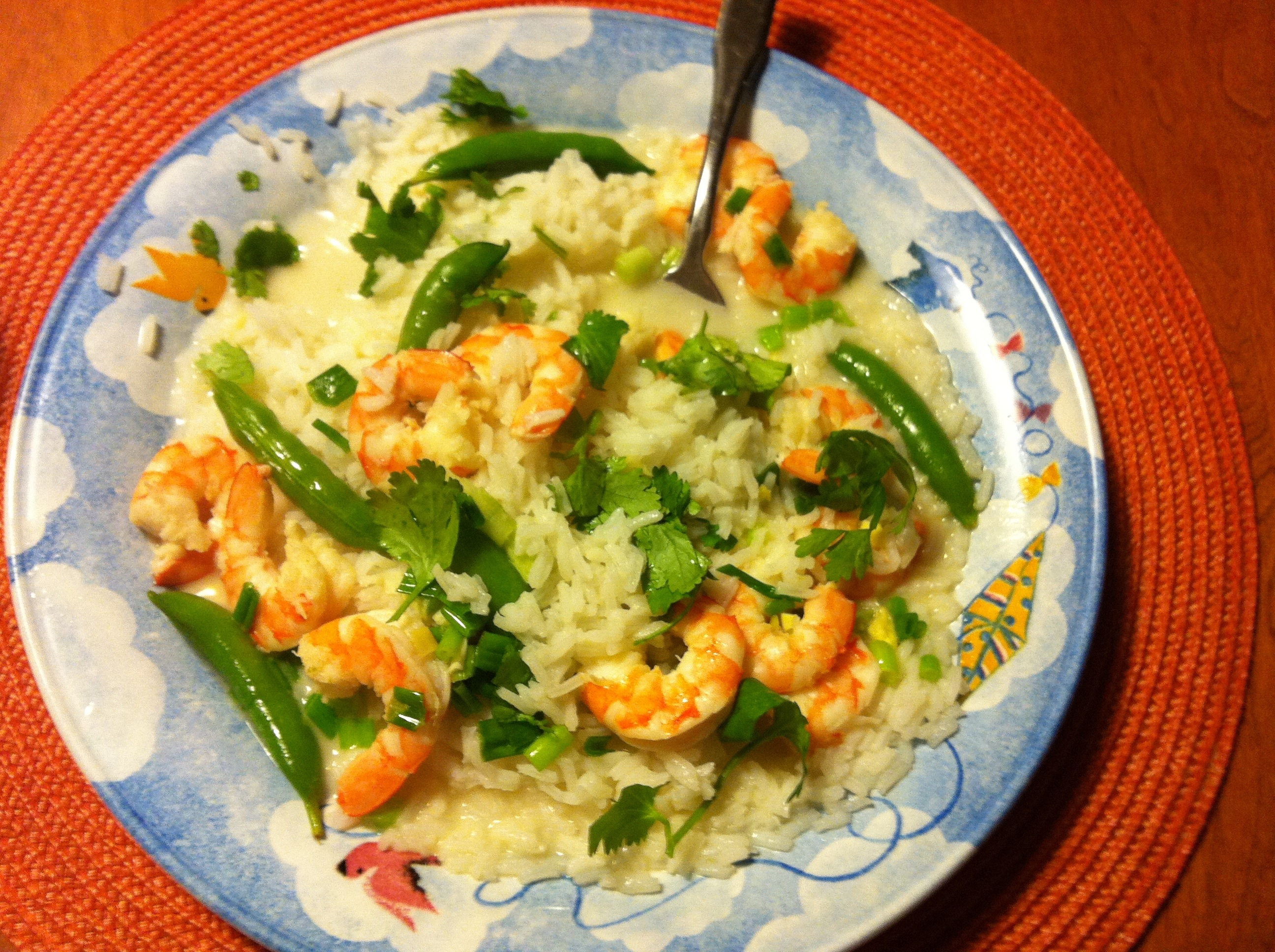
20131026-192910.jpg

Now it’s your turn. Do you know any sustainable seafood recipes? If not, a great resource is Monterey Bay Aquarium’s Seafood Watch. You can even create your own dishes! Leave your recipes in the comments or even make them yourself and share it on Facebook or your own blog and send me the link. I will post any recipes I receive and might even make a few myself if they sound really good! The most important thing is that the seafood is sustainable and you have fun while helping the Vaquita!

I look forward to seeing what all you cooks out there can stir up! 😉
Expedition summary

The 2013 Vaquita Expedition has drawn to a close. Though it was not exactly what everyone had been hoping for, there were some upsides to the expedition. Here is the email I received from Tom Jefferson on Friday:

“Greetings,
We have just returned from our 24-day Vaquita photographic expedition in San Felipe. The project had some bad luck and we were not able to get high-quality images of Vaquitas, as we had hoped. Here are some lowlights and highlights of the project:

Lowlights
1) The only Vaquita images obtained were very distant and blurry.
2) Of 22 potential days to work, nearly half (10) were too windy to even consider going out to sea. We had very little calm conditions (Beaufort 0-1), which is important for finding Vaquitas.
3) In one of our sightings that presented good photo prospects, three large trawlers moved through and scared the Vaquitas away just as we were attempting to get photos.
4) We did not observe any fishing with the new mini-trawl nets.

Highlights
1) We conducted 558 miles of searches for Vaquitas while traveling in two boats.
2) We conducted over 20 hours of intensive ‘stop and drift’ searches while sitting in the water with engines off.
3) We had 11 cetacean sightings (including several groups of long-beaked common dolphins, and large whales).
4) We observed three groups of Vaquitas at relatively close range.
5) We did not observe any illegal fishing with gillnets in the Vaquita Refuge.
6) We conducted a talk on the Vaquita for about 45 people at El Dorado Ranch.
7) We distributed educational brochures and coloring books to several businesses in town.

We are disappointed that we did not obtain any high-quality Vaquita images this year, but are not giving up. We are re-evaluating our approach for future expeditions.

Best wishes,
Tom
¡VIVA Vaquita!”

I was, of course, frustrated that the weather did not cooperate, and that once again the bad timing of large vessels scared away good photo subjects. It would have been incredible to get new Vaquita images to use for publicity, or at least witness the use of Vaquita-friendly fishing gear. Though it wasn’t an ideal mission, there are a few very important positives that we should focus on. First of all is the fact that they were able to go on the expedition in the first place. This means that they are getting the funding they need in order to successfully complete the endeavors they feel necessary to save the Vaquita. Going by the goals that I set in previous posts, the mission was technically a success in that they saw multiple groups of Vaquitas (more than in 2010!) as well as no illegal fishing. Firstly, this means that they are still alive and probably reproducing because when Vaquita are in groups it usually includes a mother and her calf, which would have been born in the spring, meaning Vaquitas were mating within the last few years and hopefully the summer of this year so calves are born next spring. Secondly, if there are no gillnets in the Vaquita Refuge, then the mortality rate of the species will be about zero, meaning any births will increase the population. I hope this expedition helped and will continue to help the spreading of awareness for the Vaquita, from the talk, to the brochures, to the coloring books. It would also be great if everyone reading this post shared their knowledge of the Vaquita on all their social networks and to all their friends. There is still hope for the Vaquita if we work together!

Expedition progress

Dr. Tom Jefferson just sent me some good news! Though the weather has not been ideal so far during the expedition, there has been a Vaquita sighting! Here is what he wrote:

“We have not had very good weather so far, but we did have one very calm day with a single Vaquita sighting very close to the boats. Three animals, but the photos did not turn out well.”

I was very excited to read this, and filled with hope that if the weather is calm for the next two weeks, they will get some really good Vaquita photos! Stay tuned.

Memuco exhibition

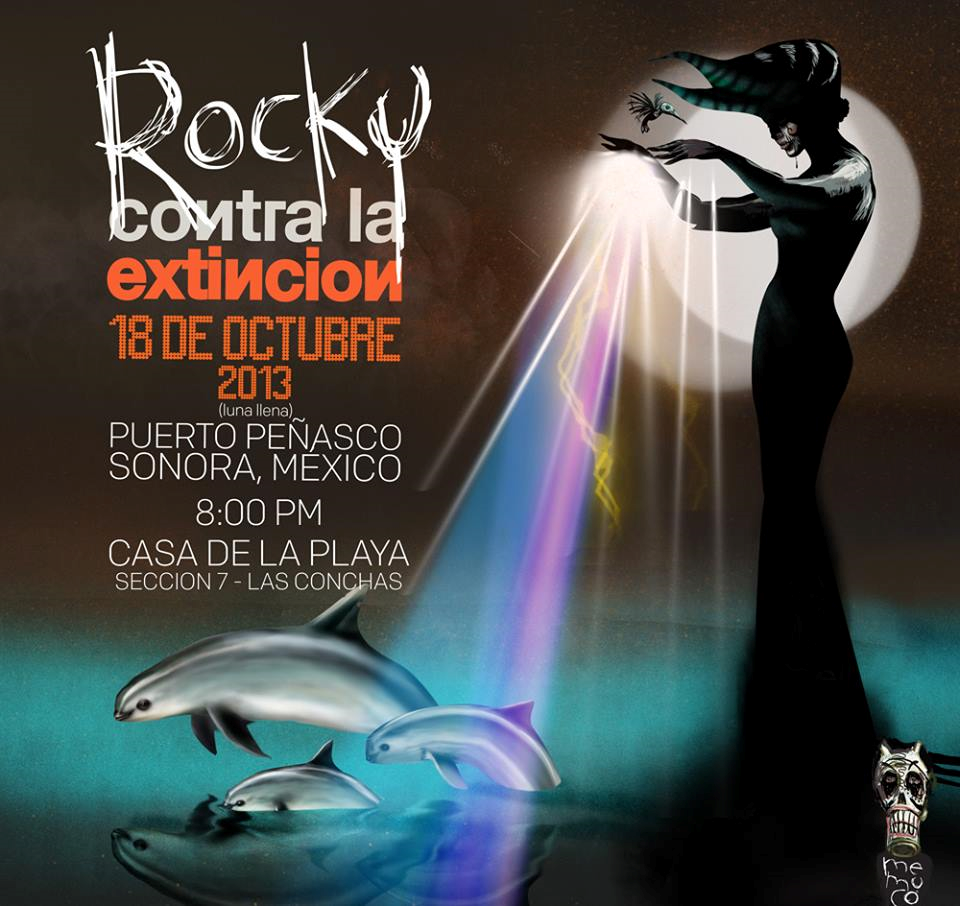
If you are near Puerto Peñasco, Mexico this month, please check out Memuco‘s art exhibition on October 18 (full moon). Here is a beautiful poster for the event. I also believe he will be in Mexico for the whole month of October and the Day of the Dead on November 1 and 2. Also, I still cannot thank him enough for illustrating my book‘s cover!

Memuco exhibition

CEDO Eco Shop

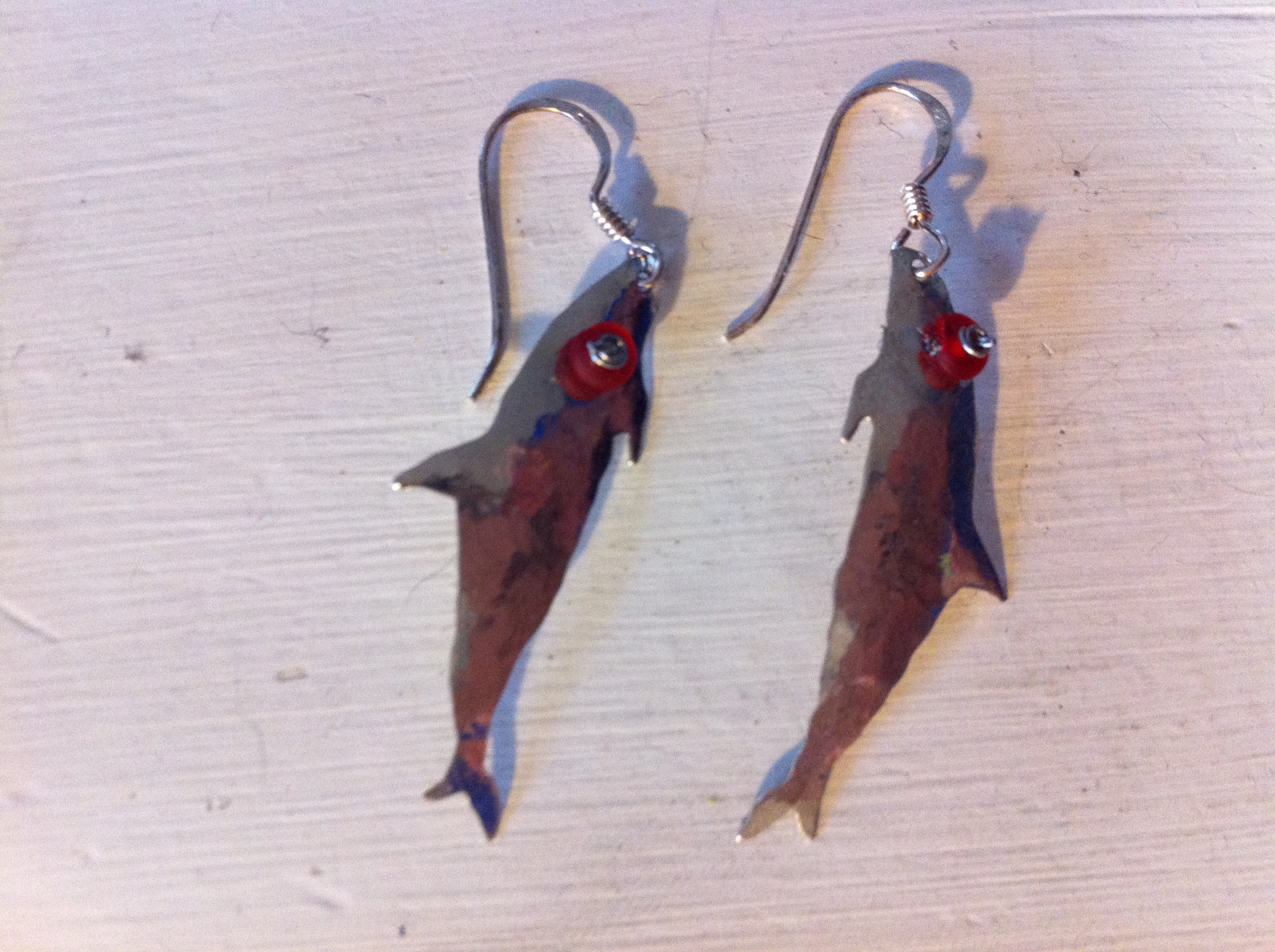
I just received an awesome package from the CEDO Eco Shop, the gift store of the Intercultural Center for the Study of Deserts and Oceans. They have so many amazing items, including a Vaquita section where the profits go to our favorite little cetacean. I bought my sister some nice Vaquita earrings (the only available ones in the world to my understanding) created by local women who live in Puerto Peñasco, one of the 3 towns surrounding the Vaquita’s range. They were only $10, but you can purchase different types at various prices.

Earrings

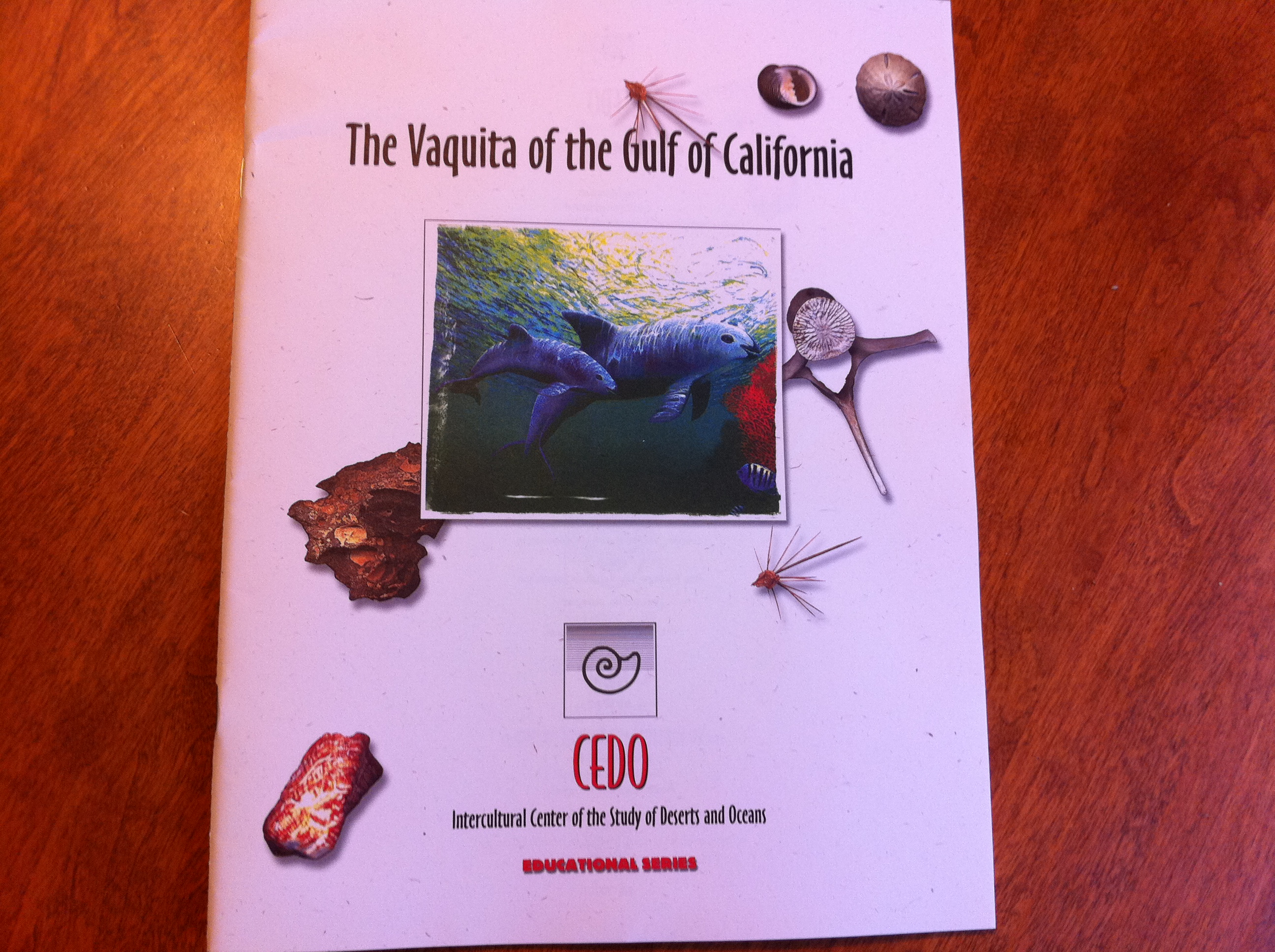
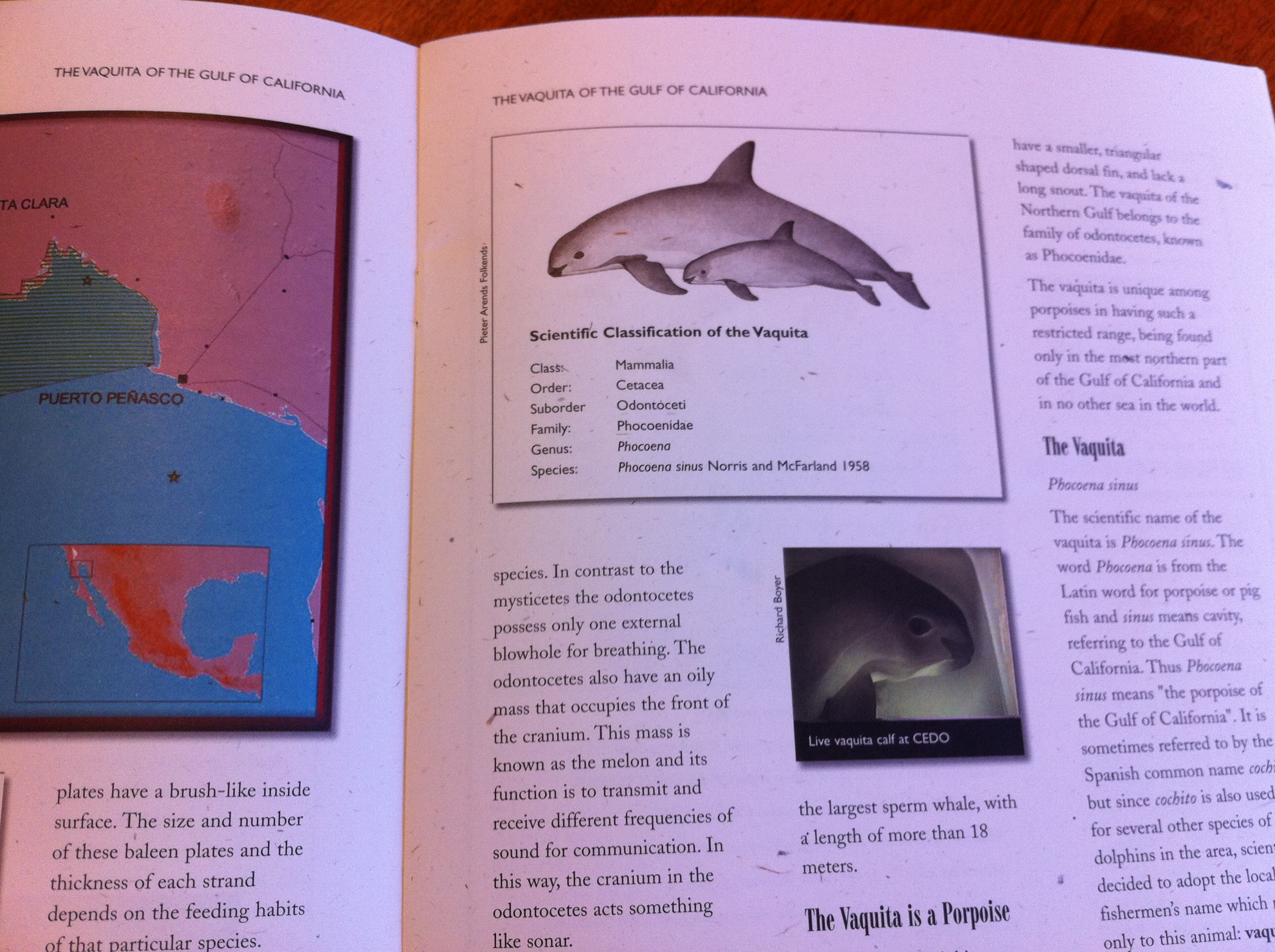
Another great Vaquita item I bought was the CEDO publication “The Vaquita of the Gulf of California.” The 28-page magazine-style book from 2002 is very interesting and absolutely worth its bargain price of $5. Please consider purchasing some of the incredible items in this gift shop!

The Vaquita of the Gulf of California

Interior

An amazing feature I found in the Eco Shop was their Amazon “portal,” which is a link to the same Amazon page we all know and love, except on this one, when you purchase anything, a portion of the profits goes to CEDO! So if you want to donate to CEDO and the Vaquita, but also really want that pair of shoes you saw on Amazon a few days ago, click the link below and shop away with a lot less guilt. 😉

You can also buy my Vaquita book with that link, and in doing so, donate to at least 3 Vaquita charities at once! You can also buy it here: https://www.createspace.com/4268018. In addition, please read this extremely nice article from the website “Greening the Beige” about my book: http://greeningthebeige.org/gtb/node/1863.

Hey, I almost forgot to ask! How did you find this blog? Was it from a Google search? A link on another website? Or something else? Please submit your answer in the poll in the sidebar, to help me learn how to maximize this blog’s viewing. Thanks from the Vaquita!

New Vaquita short film

*Video and article currently unavailable.

Chris Johnson of earthOCEAN, creator of the http://vaquita.tv/ website and the famous Vaquita documentary, “Last Chance for the Desert Porpoise,” has recently released a new short film about the Vaquita, titled “Saving the Desert Porpoise.” It is an update on the documentary from 2008, with new info, graphics, and interviews. It is a perfect video to get completely up to date on the Vaquita’s situation. Please read Chris’s article about the film and watch it below: http://vaquita.tv/blog/2013/10/04/new-vaquita-short-film/.

http://vimeo.com/58132769

http://vimeo.com/58132769

Increasing awareness

Today I finished reading the North American Conservation Action Plan (NACAP) for the Vaquita. You can read it online here: http://www.cec.org/Storage/62/5476_Vaquita-NACAP.pdf (the English section starts on page 48).

It is a very in-depth paper from 2008 with extremely important and relevant information. It reaches a similar conclusion to many other papers in that the fishermen are willing to help the Vaquita as long as they do not lose their income for it and their families can still be sustained. Basically the entire world wants to help the Vaquita, including the fishermen, so really all that needs to be done is our governments work together to complete all of the goals required to save it before time runs out.

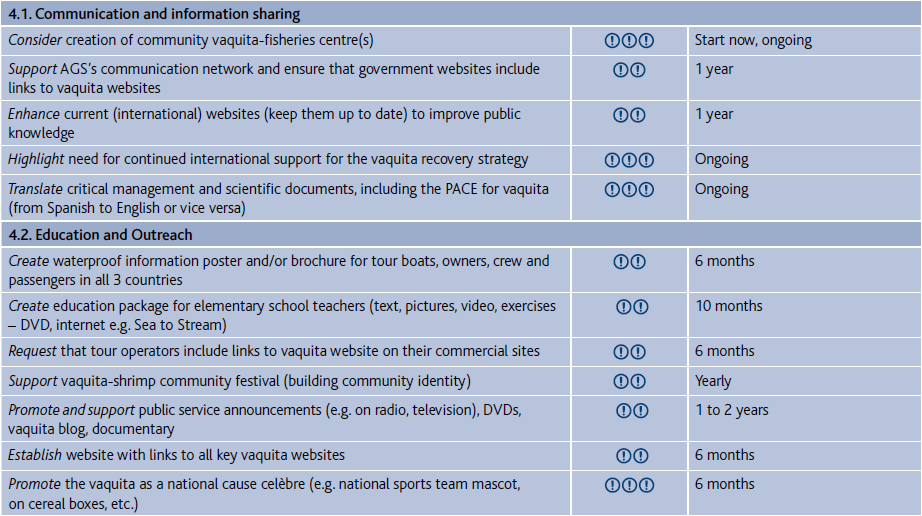
I was particularly interested in the matrix provided on pages 76-79 that charts all of the priorities for saving the Vaquita, as of 2007, according to the CEC. Many of the things listed have already been done, which is promising. Below is the section for increasing awareness, with the first box containing the action, the second showing the priority (more ! = more important), and the third showing the time frame. I am really excited to try to help make these things happen, and I am sure the Muskwa Club will play a crucial role in these endeavors. All of these things are past their due date, but that does not mean they shouldn’t be done. Earlier in the paper it states, “The [conservation] sector also stressed the value of having information flow smoothly among the various sectors [fishing, aquaculture, tourism, and conservation] so that problems can be identified and solutions sought in a timely, efficient manner.” This idea is extremely similar to the Muskwa Club’s idea of the Vaquita Preservation Alliance, which I will write about once the details are figured out after the Muskwa Club – American Cetacean Society Los Angeles meeting on October 25.

(Click the chart if the words are too small.)

Increasing awareness