Expedition summary

The 2013 Vaquita Expedition has drawn to a close. Though it was not exactly what everyone had been hoping for, there were some upsides to the expedition. Here is the email I received from Tom Jefferson on Friday:

“Greetings,
We have just returned from our 24-day Vaquita photographic expedition in San Felipe. The project had some bad luck and we were not able to get high-quality images of Vaquitas, as we had hoped. Here are some lowlights and highlights of the project:

Lowlights
1) The only Vaquita images obtained were very distant and blurry.
2) Of 22 potential days to work, nearly half (10) were too windy to even consider going out to sea. We had very little calm conditions (Beaufort 0-1), which is important for finding Vaquitas.
3) In one of our sightings that presented good photo prospects, three large trawlers moved through and scared the Vaquitas away just as we were attempting to get photos.
4) We did not observe any fishing with the new mini-trawl nets.

Highlights
1) We conducted 558 miles of searches for Vaquitas while traveling in two boats.
2) We conducted over 20 hours of intensive ‘stop and drift’ searches while sitting in the water with engines off.
3) We had 11 cetacean sightings (including several groups of long-beaked common dolphins, and large whales).
4) We observed three groups of Vaquitas at relatively close range.
5) We did not observe any illegal fishing with gillnets in the Vaquita Refuge.
6) We conducted a talk on the Vaquita for about 45 people at El Dorado Ranch.
7) We distributed educational brochures and coloring books to several businesses in town.

We are disappointed that we did not obtain any high-quality Vaquita images this year, but are not giving up. We are re-evaluating our approach for future expeditions.

Best wishes,
Tom
¡VIVA Vaquita!”

I was, of course, frustrated that the weather did not cooperate, and that once again the bad timing of large vessels scared away good photo subjects. It would have been incredible to get new Vaquita images to use for publicity, or at least witness the use of Vaquita-friendly fishing gear. Though it wasn’t an ideal mission, there are a few very important positives that we should focus on. First of all is the fact that they were able to go on the expedition in the first place. This means that they are getting the funding they need in order to successfully complete the endeavors they feel necessary to save the Vaquita. Going by the goals that I set in previous posts, the mission was technically a success in that they saw multiple groups of Vaquitas (more than in 2010!) as well as no illegal fishing. Firstly, this means that they are still alive and probably reproducing because when Vaquita are in groups it usually includes a mother and her calf, which would have been born in the spring, meaning Vaquitas were mating within the last few years and hopefully the summer of this year so calves are born next spring. Secondly, if there are no gillnets in the Vaquita Refuge, then the mortality rate of the species will be about zero, meaning any births will increase the population. I hope this expedition helped and will continue to help the spreading of awareness for the Vaquita, from the talk, to the brochures, to the coloring books. It would also be great if everyone reading this post shared their knowledge of the Vaquita on all their social networks and to all their friends. There is still hope for the Vaquita if we work together!
Memuco exhibition

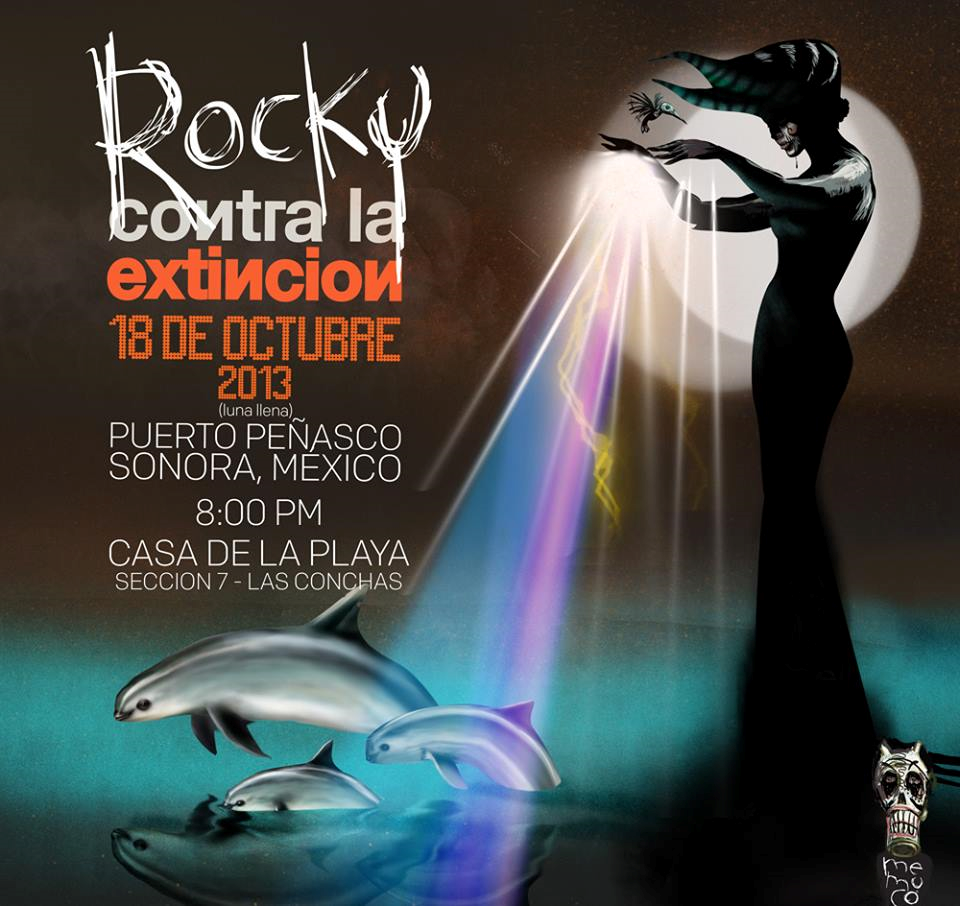
If you are near Puerto Peñasco, Mexico this month, please check out Memuco‘s art exhibition on October 18 (full moon). Here is a beautiful poster for the event. I also believe he will be in Mexico for the whole month of October and the Day of the Dead on November 1 and 2. Also, I still cannot thank him enough for illustrating my book‘s cover!

Memuco exhibition

Increasing awareness

Today I finished reading the North American Conservation Action Plan (NACAP) for the Vaquita. You can read it online here: http://www.cec.org/Storage/62/5476_Vaquita-NACAP.pdf (the English section starts on page 48).

It is a very in-depth paper from 2008 with extremely important and relevant information. It reaches a similar conclusion to many other papers in that the fishermen are willing to help the Vaquita as long as they do not lose their income for it and their families can still be sustained. Basically the entire world wants to help the Vaquita, including the fishermen, so really all that needs to be done is our governments work together to complete all of the goals required to save it before time runs out.

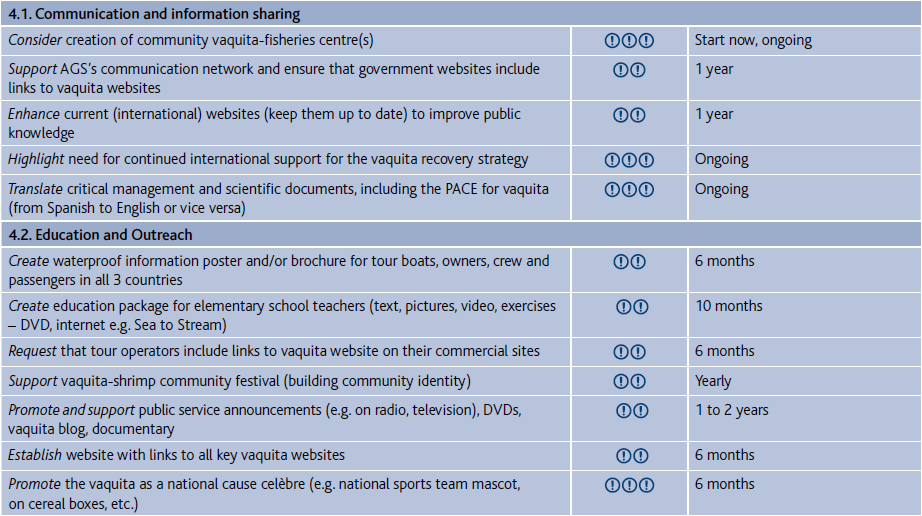
I was particularly interested in the matrix provided on pages 76-79 that charts all of the priorities for saving the Vaquita, as of 2007, according to the CEC. Many of the things listed have already been done, which is promising. Below is the section for increasing awareness, with the first box containing the action, the second showing the priority (more ! = more important), and the third showing the time frame. I am really excited to try to help make these things happen, and I am sure the Muskwa Club will play a crucial role in these endeavors. All of these things are past their due date, but that does not mean they shouldn’t be done. Earlier in the paper it states, “The [conservation] sector also stressed the value of having information flow smoothly among the various sectors [fishing, aquaculture, tourism, and conservation] so that problems can be identified and solutions sought in a timely, efficient manner.” This idea is extremely similar to the Muskwa Club’s idea of the Vaquita Preservation Alliance, which I will write about once the details are figured out after the Muskwa Club – American Cetacean Society Los Angeles meeting on October 25.

(Click the chart if the words are too small.)

Increasing awareness

2013 shrimp season starts

On September 5, the Sonoran shrimp seasons commenced. The season generally begins in early September and ends in April, meaning you can shrimp during every month with the letter “r” in it. For the first ten days of the season, only artisanal panga fishermen, ribereños, are allowed to shrimp. But starting Sunday the 15th, the enormous trawling boats, cameroneros, are allowed to set sail. Both are of danger to the Vaquita unless they are outside of the Vaquita’s range and/or using Vaquita-safe trawls. This is an important time for Vaquita conservation because we will be able to see the Official Norm regulation hopefully be put into action. It would also be nice if all the fishermen follow the law and stay out of the Biosphere Reserve and Vaquita Refuge, but realistically, that’s not going to happen, at least not yet.

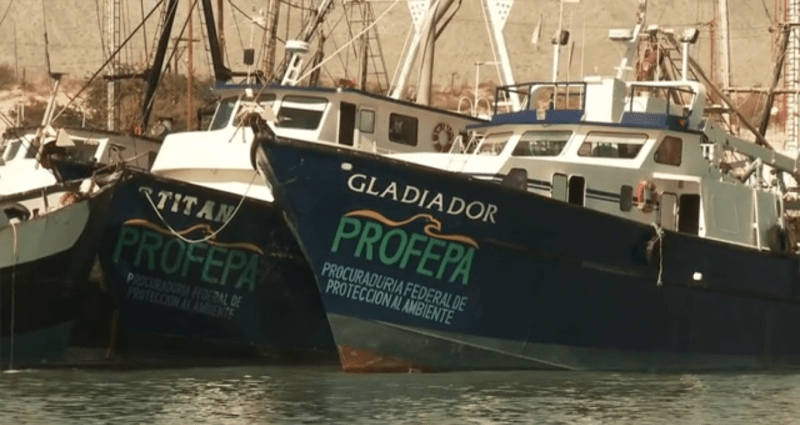
PROFEPA ships used for patrolling.  © 2008 Chris Johnson, earthOCEAN

PROFEPA boats used for patrolling.
© 2008 Chris Johnson, earthOCEAN

Hopefully PROFEPA (the part of the Mexican government in charge of patrolling the water for illegal fishing) will be out in large numbers trying to keep the reserves gillnet-free. That is another thing that will be very interesting to see during ¡Viva Vaquita!’s expedition starting the 23rd. Number one, if they see any fishermen, and if they do, what are they fishing with. I am not sure what they would do in that situation, and as cool as it would be for ¡Viva Vaquita! to go full-out Whale Wars on a tiny fishing boat using gillnets, I believe they would handle it very calmly and probably radio to PROFEPA, or something along those lines. The second thing that will be interesting to see will be if the ¡Viva Vaquita! team is spotted by PROFEPA, and if they are, will they be inspected for permits. Here is an excerpt from the blog of their 2010 expedition (hopefully they will have a blog this year too) about this very situation, which happened to be at the exact time they saw their only Vaquita during the entire 3-week trip:

“Captain Antonio sighted a Vaquita off the port-bow that surfaced twice and avoided the boat. We stopped to search, but at that same moment we were approached by the PROFEPA boat (Mexico’s environmental law enforcement agency) asking to see our permits. By the time the agents reviewed our paperwork, the Vaquita was gone. No one had been able to get any pictures. It was bad timing, but good to see the PROFEPA agents were doing their job.”

So my hopes for this year’s shrimping season is that no Vaquitas are killed by humans. This is definitely possible if the Official Norm is put into action and the fishermen follow the law. That way in the spring, when the calves are born, the Vaquita will finally begin its climb back from the brink of extinction.

For more information on this year’s shrimping season, read this article: http://sancarlos.tv/shrimp-season-commences-in-sonora/, and here is a great piece from Vaquita.tv about 2010’s shrimp season: http://vaquita.tv/blog/2010/09/17/big-expectations-for-the-2010-shrimp-season/.

Let’s do this!

As I am sure you know by now if you have read some of my previous posts, Mexico made a new law (called the Official Norm) that requires all shrimp gillnets to be switched out with Vaquita-safe trawls within the next 3 years. This is obviously enormous news, so even some of the major groups wrote articles about it, among them the WWF, the organization whose petition caused the law to be created in the first place.

However, few to no articles talk about what happens next.

This law is only affecting shrimp gillnets, because they are the only ones who have a Vaquita-safe substitute so far. Finfishing gillnets pose just as big, if not bigger, of a threat to the Vaquita, so they obviously need to be replaced as well. Currently, there are Vaquita-safe finfishing trawls being developed and tested, so hopefully they prove effective and can be implemented in the Gulf as well within the next couple of years, before it is too late.

The other part of the puzzle with this law is the cooperation of the fishermen and the commitment of the government. We are all hoping that the government really does follow through with this plan and succeeds, and from what I can tell, they mean business with this law. They really do want to save the Vaquita, and I believe they will as long as one factor falls into place: the fishermen.

In the end, it is all up to the fishermen. No matter how strict the government gets, the fishermen will be able to slip through their grasp and fish illegally. That is, if the fishermen would rather risk it all just to fish with gillnets. The law plans to train each fishermen on how to use the trawls and compensate them, meaning there is no real loss for the fishermen that participate in this mandatory law. The trawls are a lot more expensive than gillnets, so the government is going to need to use a lot of their tax dollars to make it happen. If you are a Gulf fishermen, please do the right thing and follow the law. Participate in the Official Norm, and tell every other fishermen to do the same. If you live in Mexico, know that every item you buy with tax could be helping save one of your national icons.

You. Yes, you sitting there reading this post. I want you to help this law succeed too. First off, DO NOT BUY FISH OR SHRIMP FROM THE GULF OF CALIFORNIA CAUGHT WITH GILLNETS! If there is no business, there will be no reason to fish. The next thing to do is sign my new and improved petition to the Mexican president, SEMARNAT, and PROFEPA, which asks them to do the things I wrote about in this post:

http://www.change.org/petitions/save-the-elusive-vaquita

Thank you so much for your help! If you would like to learn everything you can about the Vaquita while also donating to the species, please buy the first ever Vaquita book, written by me, here: https://www.createspace.com/4268018.

Together, we can save the Vaquita. Let’s do this!

Perspective

This weekend I did a lot of catch-and-release fishing with my cousins in Barnegat, New Jersey, where I was able to witness firsthand many fish and almost as many ways to catch them. We caught at least 35 fish from 5 different species.

The experience was interesting for me in a few ways. First, I learned a lot about fishing. Since this exact activity is what is wiping out the Vaquita, an animal that I am dedicating a large portion of my life to, I want to learn everything I can about the other side of the duel. When I am getting ready for a tennis tournament, I don’t just work on my own game, I also study my opponent and how he plays. We need to do the same exact thing for the Vaquita vs. Fishermen matchup. That means listening to the fishermen. They are not our enemy. They are just humans doing their job. Unfortunately, their job is wiping out an entire species. We need to fully understand both sides of the dilemma in order to solve it. I have been researching a lot about gillnets, pangas, and everything about fishing in the Gulf. The simple answer is: they will not be able to stop fishing, so we need to get them to use Vaquita-safe gear. Fortunately, as you probably know, the Mexican government has announced that all shrimp gillnets will be switched to Vaquita-safe trawls within the next 3 years. Albeit a huge step, it is only the first of many needed to save the Vaquita.

The second way the experience was interesting was the sheer number of animals that we pulled out of a small bay during a few hours of fishing. At least 35. Or a flock of starlings I saw on the ground today of at least 200 birds. I then realized how vulnerable the number 200 is when you are talking about population. That flock of birds could fly into a reflective glass building and be gone. Just like that. There are at most 200 Vaquitas left on the planet. Gillnets are the Vaquita’s reflective glass building. Theoretically, the Vaquita could go extinct tonight. But hopefully they are still here tomorrow, so we can get to work on getting every last gillnet out of the Gulf of California and hanging them up forever.

The third way it was interesting is that I was able to put myself in the fishermen’s shoes. I pretended that I was a fisherman and that I needed to catch fish in order to feed my family. It really changed my perspective on the situation. I realized how fishing is anything but a hobby for the Gulf fishermen. It is absolutely a job, and a competitive one at that. As leading Vaquita expert Barbara Taylor once said of fishing in the Gulf, “If you don’t catch any shrimp, your neighbor will.” When I put myself in the fishermen’s situation, there was a new urgency to catch each fish, and I can only imagine what the pressure is like in real life. If I were them, I would use the best gear possible and nothing else. Fortunately, the Vaquita-safe trawls are as effective as gillnets, but more expensive. We need more awareness, therefore money, towards the Vaquita and the switch-out program. So please, spread the word and raise money in any way you can possibly think of. I would love to hear your ideas and questions in the comments section. Thank you!

Vaquita vacation

I have put together a travel itinerary for a vacation to Mexico for a Vaquita enthusiast. Please check it out and consider taking a one-week getaway using my outline for ideas. This vacation is designed to provide maximum enjoyment for you and maximum publicity and assistance for the Vaquita:

Vaquita Vacation

Change the Course

Please read this awesome article and Take the Pledge to help Change the Course restore the Colorado River and save the Vaquita! You can also text ‘RIVER’ to 77177 to take the pledge and receive updates on the project. For each pledge, 1,000 gallons of water will be added back to the Colorado River! Please take the pledge to use less water and save the Colorado, which could be another piece in the puzzle of saving the Vaquita. The enormous river used to flow in massive amounts into the Gulf of California, until the delta was riddled with dams. It is not known for sure how such damming affects the Vaquita, but we do know that the water needs to be returned to the Gulf for political reasons, which you can read about in the article above. The Change the Course project is a coalition of TakePart, National Geographic, Participant Media, and BEF, and you can watch a video about the project below: