Vaquita Blanket Challenge

TAKE THE VAQUITA BLANKET CHALLENGE AND NOMINATE YOUR FRIENDS TO DO THE SAME!
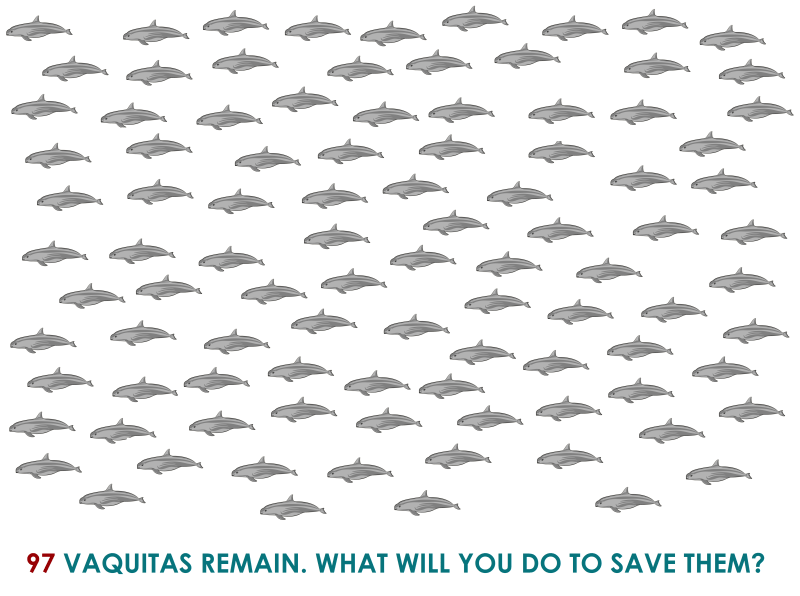
The Vaquita porpoise is the world’s most endangered marine mammal with only 97 left in existence. They live in only in a small area within the Sea of Cortez between Baja and mainland Mexico. They drown when caught in gill nets set for shrimp or by poachers trying to capture another endangered fish, the Totoaba for their swim bladders considered a delicacy in Chinese restaurants. The Vaquita can be saved if the poachers are stopped and the fisherman switch to the vaquita safe trawl nets provided for them by the Mexican government. Yet, with most people unaware of the problem, there is reluctance to take these steps in time! Help us save the Vaquita by taking the Vaquita Blanket Challenge, posting about it and nominating your friends to do so as well. If we can raise awareness of this issue, we will have a chance to save a species! Let’s work together to do it!
How to Take the Vaquita Blanket Challenge:
Get two twin bed size blankets. Lay on the first blanket with your feet crossed at the ankles like a Vaquita tail and your arms behind your back with your hands clasped at the small of your back. Have someone wrap you tightly (roll you up in) the first blanket and then the opposite way in the second blanket. Now, have someone time you trying to get out without rolling over, without standing up and with minimal use of your arms. Can you get out in 97 seconds? Post your time along with this message (and optionally a video or picture of you taking the challenge) on social media, email it to your friends, and nominate 3 other friends to do so as well. Did you feel momentarily trapped like a Vaquita might feel in a net? If you’ve taken the challenge, you are eligible to buy and wear the Vaquita Blanket Challenge T-shirt at: http://www.booster.com/vaquitablanketchallenge. You can also make a donation toward the Muskwa Club’s efforts to save the Vaquita. Wear your shirt with pride to help spread the word about the Vaquita before it’s too late!
Front
Back


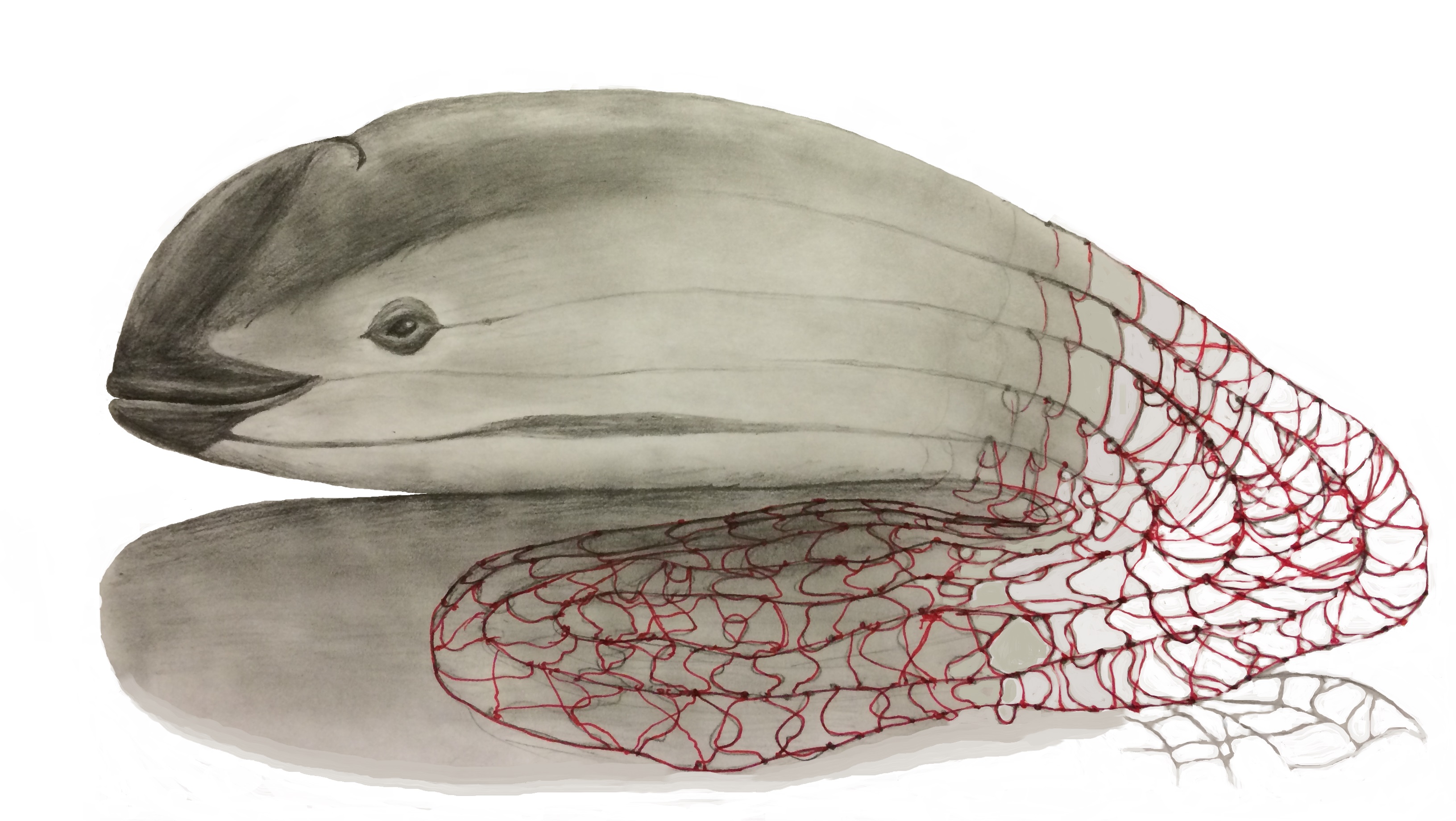
Morph

Morph

This is a drawing called “Morph.” It represents the complexity of the Vaquita’s situation by showing how vague the difference between the Vaquita and its killer—the gillnet—is. Is there a good side? Or are they both good—or neither? I believe that this is one of the few situations where the murderer is not an antagonist.

The fishermen are people with families that are doing all they can to keep food on the table and a roof over their heads.

The Vaquita is an innocent little porpoise that has never harmed a human being, yet has been forced to don the title of most endangered marine mammal. Their predicament is the unfortunate side effect of an economically efficient fishing method.

There will never be a story about the Vaquita without mention of gillnets. They go hand-in-hand, and always will. Let’s just hope that in the future we will be talking about the Vaquita’s conquering of gillnets, not vice versa.

In the end, it is up to the fishermen to make a very difficult choice: illegally fishing for temporary wealth but driving the Vaquita to extinction and destroying the Gulf’s ecosystem, or switching to admittedly expensive alternative gear that preserves the Vaquita and the food chain as well as giving their families eventual wealth. Our job is to convince them to choose the second one. In addition to spreading the word on social media, an undeniably great way to help with this problem is by donating. $50 can eliminate an entire day of gillnetting. Please consider clicking below and donating to what I believe is the worthiest cause on the planet, brought to you by GreaterGood.org. Thanks from the Vaquita.

https://m.theanimalrescuesite.greatergood.com/store/ars/item/62276/save-the-critically-endangered-vaquita


American Cetacean Society

The American Cetacean Society is one of the leaders in Vaquita conservation. Founded in 1967 and comprised of 7 chapters and a Student Coalition, they are the world’s first organization dedicated to saving whales. Here are the links to the chapters:

Los Angeles
Monterey Bay
Orange County
Puget Sound
San Diego
San Francisco Bay
Oregon
Student Coalition

The Monterey Bay Chapter was one of the 3 founding members of ¡Viva Vaquita!, and the Los Angeles Chapter has been an extremely helpful ally to the Muskwa Club. The American Cetacean Society has two publications, the quarterly newsletter, Spyhopper, and the biannual, theme-specific Whalewatcher. In 2010 they published a Whalewatcher about porpoises, especially the Vaquita. The two most recent Spyhoppers also featured amazing articles about the Vaquita:

Viva Vaquita by Ayla Glim, Pages 6-8: http://acsonline.org/wp-content/uploads/2013/07/SpyhopperQtr2-2013-FINAL_2.pdf

Vaquita, Net Gains and Net Losses by Barbara Taylor, Pages 1-5: http://acsonline.org/wp-content/uploads/2013/11/Spyhopper-Nov.-2013.pdf

The November issue shocked me with these few paragraphs!

“For the first time since I’ve been working with Vaquita there are some concrete steps that people from outside Mexico can do (or will be able to soon), and here are three things you can do to help:

1. Support Vaquita-safe seafood products
Fishermen are more likely to convert to Vaquita-friendly fishing gear if there is market incentive to do so. WWF Mexico (http://wwf.panda.org/who_we_are/wwf_offices/mexico/?208988/Mexico-approves-measure-to-save-worlds-rarestmarine-mammal) with funds from the US Marine Mammal Commission and several private foundations are planning a series of events to promote Vaquita-safe seafood. The hope is that this will do for Vaquita what ‘dolphin-safe’ labeling on cans of tuna did for millions of dolphins in the eastern Pacific. These events will feature top chefs serving Vaquita-safe shrimp alongside Vaquita wine. The idea is to connect the fishermen who are sustainably harvesting seafood with outlets that cater to conscientious consumers, and rewarding those fishermen with a bit higher price for their value-added product. The events will need planning, labor, and folks to enjoy the food.

2. Establish and support grassroots education and fund-raising campaigns
There is a need for educating the public about Vaquita. Last year saw the first “Save the Vaquita Day” initiated by a grassroots effort by elementary, middle and high school students of the Muskwa Club founded in Long Beach, California https://sites.google.com/site/muskwaclub/ with the support from several ACS chapters. The Muskwa Club even made a nice video, which can be seen at: http://www.youtube.com/watch?v=Zj3T724txo4. This tri-coastal campaign reached thousands of people through Vaquita events and we can hope that this effort grows. These events and future plans can be seen on the website above and in the ACSLA Chapter report. The group ¡Viva Vaquita! (http://www.vivavaquita.org/) also continues to attend events and do programs in schools to raise awareness, and has just distributed educational brochures and coloring books to schools near the fishing port of San Felipe, Mexico. A kindergarten class at Frances Parker School in San Diego adopted Vaquita as their special project and raised funds. The Marine Mammal Center (TMMC http://www.marinemammalcenter.org/), can accept funds by sending checks to Frances Gulland at their address with a note that the funds are for saving Vaquita. A few times a year, TMMC will transfer those funds to support WWF-Mexico projects aimed at training shrimp fishermen in the northern Gulf how to use alternative gear. Vaquita.tv continues to be an excellent source of on-line information and a great place to send people who want to learn more about Vaquita and the people’s needs in the northern Gulf.

3. Stay informed; stay involved
The other important role for cetacean fans is to be avid (even pesky!) consumers and purveyors of Vaquita information. Both the IUCN and the Society for Marine Mammalogy have repeatedly written letters to the Mexican government – but letters from other concerned citizens and organizations are needed to keep this issue on the front burner in Mexico. Vaquita needs an informed fan base to keep its status in the spotlight, to make clear that there is international interest in fate of this hapless porpoise, and that the eyes of the world are on Mexico over this issue. An inspirational example of citizen involvement is Aidan Bodeo-Lomicky, a 13-year old boy from Pennsylvania who has just written a book and maintains a blog https://vlogvaquita.com/ on Vaquita conservation!”

The Muskwa Club and I are very excited and grateful to see these new progressions (and the shout outs!), as well as all of the work the ACS has done in its legendary history. Please consider donating to them: http://acsonline.org/support-acs/donate-online/, as well as the ACSLA’s Vaquita switch-out fund by sending a check to P.O. Box 1208, San Pedro, CA 90733-1208. It is very important that you write “Vaquita” on the memo line for it to go to the switch-out.

Let’s do this!

As I am sure you know by now if you have read some of my previous posts, Mexico made a new law (called the Official Norm) that requires all shrimp gillnets to be switched out with Vaquita-safe trawls within the next 3 years. This is obviously enormous news, so even some of the major groups wrote articles about it, among them the WWF, the organization whose petition caused the law to be created in the first place.

However, few to no articles talk about what happens next.

This law is only affecting shrimp gillnets, because they are the only ones who have a Vaquita-safe substitute so far. Finfishing gillnets pose just as big, if not bigger, of a threat to the Vaquita, so they obviously need to be replaced as well. Currently, there are Vaquita-safe finfishing trawls being developed and tested, so hopefully they prove effective and can be implemented in the Gulf as well within the next couple of years, before it is too late.

The other part of the puzzle with this law is the cooperation of the fishermen and the commitment of the government. We are all hoping that the government really does follow through with this plan and succeeds, and from what I can tell, they mean business with this law. They really do want to save the Vaquita, and I believe they will as long as one factor falls into place: the fishermen.

In the end, it is all up to the fishermen. No matter how strict the government gets, the fishermen will be able to slip through their grasp and fish illegally. That is, if the fishermen would rather risk it all just to fish with gillnets. The law plans to train each fishermen on how to use the trawls and compensate them, meaning there is no real loss for the fishermen that participate in this mandatory law. The trawls are a lot more expensive than gillnets, so the government is going to need to use a lot of their tax dollars to make it happen. If you are a Gulf fishermen, please do the right thing and follow the law. Participate in the Official Norm, and tell every other fishermen to do the same. If you live in Mexico, know that every item you buy with tax could be helping save one of your national icons.

You. Yes, you sitting there reading this post. I want you to help this law succeed too. First off, DO NOT BUY FISH OR SHRIMP FROM THE GULF OF CALIFORNIA CAUGHT WITH GILLNETS! If there is no business, there will be no reason to fish. The next thing to do is sign my new and improved petition to the Mexican president, SEMARNAT, and PROFEPA, which asks them to do the things I wrote about in this post:

http://www.change.org/petitions/save-the-elusive-vaquita

Thank you so much for your help! If you would like to learn everything you can about the Vaquita while also donating to the species, please buy the first ever Vaquita book, written by me, here: https://www.createspace.com/4268018.

Together, we can save the Vaquita. Let’s do this!

Last chance for this month’s donation

If you buy my book before the midnight of tomorrow, August 1, 25% of the proceeds will go to ¡Viva Vaquita! in the very first monthly donation. Every month, I will be donating 25% of my book’s proceeds to ¡Viva Vaquita!, with the rest going to the ACSLA’s switch-out program and many other Vaquita causes. If you would like to donate to the Vaquita while receiving the first ever book on it, please visit https://www.createspace.com/4268018 and buy as many books as you would like. Thank you so much from the Vaquita! I will give the details of the donation after the deadline.

The big 3

According to leading Vaquita researcher Dr. Lorenzo Rojas-Bracho, there are 3 initiatives that we members of the general public can participate in to legitimately make a difference in the Vaquita’s situation. They are:

1. Raise awareness
2. Convince restaurants to only buy their shrimp from safe sources
3. Raise money towards the switch-out program

The first one has so many different levels to it. This blog is an example of the online branch of public awareness, as is a Vaquita-related Facebook post. Another branch is face-to-face awareness, such as the tables manned by the Muskwa Club and ¡Viva Vaquita!, or a Vaquita speech at an event. Some other things that can raise awareness are books (mine is the only one so far), pamphlets, or public service announcements (especially on the radio). The online branch is the easiest and most effective, because you can instantly send information around the world with the click of a button. The hard part is getting the information to a large enough audience with the information being worthwhile enough that they will, in turn, pass it around to other people. Luckily, the Vaquita is a very worthwhile cause. So all you need to do is start a chain of posts about it, and those very posts could end up being read by every person on earth.

The second one is only for the dedicated Vaquita conservationist. It would require quite a bit of research and getting out of the house. For example, the next time you go to Red Lobster, ask your waiter where the shrimp comes from. If they don’t know, ask to speak with the manager. I honestly have never seen shrimp that was not farm-raised somewhere in Asia, but I always make sure. Always. Even though there is much debate as to how/where shrimp should be caught for maximum sustainability, anything other than gillnet-caught in the Gulf of California is fine from a Vaquita standpoint. It is most important to check restaurants and grocery stores for Vaquita-unsafe shrimp if you live near Mexico, in places like California and Arizona. There are many sites, including http://vaquita.tv/, that go into detail about sustainable seafood. After all, gillnet fishing is the only thing wiping out the Vaquita. Why not make sure that you aren’t supporting it?

The third and final initiative is raising money towards the switch-out program. The Muskwa Club and the American Cetacean Society Los Angeles Chapter have teamed up to create the only charity that sends money directly to the switch-out program, and nothing else. This is vital because the switch-out program is believed to be the best chance for the Vaquita, because it is unreasonable to think that the fishermen will just give up fishing for some unknown business that could get them nowhere financially. The switch-out is a best of both worlds situation, because the fishermen still can fish with the new nets that have proven to be as or more effective than gillnets, while the Vaquitas are put in little to no danger whatsoever. To donate to the new charity, please write a check to P.O. Box 1208, San Pedro, CA 90733-1208 and write Vaquita on the memo line. Yes, I know it is a cliché, but every dollar really does count. But the Muskwa Club has bigger plans. We are attempting to contact eco-conscious celebrities and billionaires as potential funding sources. Leonardo DiCaprio and Pierce Brosnan are both part of huge efforts to save tigers and whales, so why not the Vaquita? Warren Buffett just donated $2.6 billion to charity. Yes, you read that correctly. The entire switch-out program can be funded with, at most, $180 million. I am not necessarily saying we are going to get $180 million from Mr. Buffett, but it is exciting to think about what one human can do. He can literally save a species, in theory.

Maybe I will start playing the lottery.

Do your part

Today, Saturday, July 6, is National Save the Vaquita Day. If there was ever a day to help the Vaquita, today’s the day. I am asking you to do your part to save the Vaquita, even if you only do something seemingly miniscule. For example, today I am riding my bike around my neighborhood, putting Vaquita flyers in people’s mailboxes (I couldn’t man the Virginia table due to travel reasons). To do your part today, you could attend a Vaquita table (click here for a list), donate through ¡Viva Vaquita!’s website, buy my book, post a status update about the Vaquita on a social network, fill out this survey with the Vaquita’s information and range (the northern Gulf of California, Mexico), ride your bike around your neighborhood with the printable, quarter-sheet flyers below, make a pledge to have a DVD (Daily Vaquita Duty), or any combination of those. I would love to hear your ideas about how you can help the Vaquita today and every other day, so please leave what you did today in the comments. Thank you so much for your participation in this vital new holiday.

Vaquita Flyers

Amazon

*If you would like to buy the book, please purchase it from https://www.createspace.com/4268018 to make your donation as large as possible. It is the same price, but I get more profits (therefore I donate more) via this website than the ones below. They are only used for publicity for people who find it by chance, because a little money is better than no money.

My book is now available on Amazon and Amazon Europe! As I said above, please do not buy it from these sites (Amazon takes a much larger profit than the Create Space site above, so less money will go to the Vaquita via Amazon), unless you want the Kindle version more than a physical copy (the actual book is only $4 more). The Kindle version is $8.95, and you can get it on any device with Kindle (including the iPhone and iPad with the free Kindle app). The Kindle version definitely does not look as good as the paperback, so my advice is to just buy the book from https://www.createspace.com/4268018. Thanks in advance from the Vaquita!

The book is ready

After a year of writing, illustrating, and stressing out, my informational book, “The Vaquita: The Biology of an Endangered Porpoise,” is finally available! The book costs $12.95, with 100% of profits going to Vaquita research, education, and conservation (25% goes directly to ¡Viva Vaquita!). The book was written by me, illustrated by my brother, sister, and me, edited by Vaquita expert Dr. Thomas A. Jefferson (who also provided the back cover image), and the beautiful cover you can see below was by amazing artist Memuco. You can buy it here: https://www.createspace.com/4268018, and please distribute this link via social media. Buying one or more is a great way to donate while receiving the first ever Vaquita book! It will also be available on Amazon and Amazon Europe within the next week. Thank you so much for supporting me and more importantly, the Vaquita.

Cover

Switch-out charity

Thanks to William Whittenbury, the Los Angeles Chapter of the American Cetacean Society has turned our ideas for the Vaquita Conservation Society into reality. Though it is still in the beginnings, they have created a charity that sends its donations to the switch-out program, (where the government gives fishermen alternative, Vaquita-safe fishing gear) and they are the first group to do so. Right now, the only way to donate is to send a check by mail to: P.O. Box 1208, San Pedro, CA 90733-1208. It is very important that you write “Vaquita” on the memo line for it to go to the switch-out. I believe that the best chance for the Vaquita is the switch-out, because the new trawls provide the ideal results for both man and porpoise. Eventually, the charity will be much more public and have a bigger impact, but, as I said, the charity is still taking its baby steps. Please share this post with your friends (click on the title of the post and then scroll down until you see the social media buttons) and donate.

Also, a new idea is forming within the Muskwa Headquarters that could be our biggest project yet. Stay tuned.


ACSLAlogo