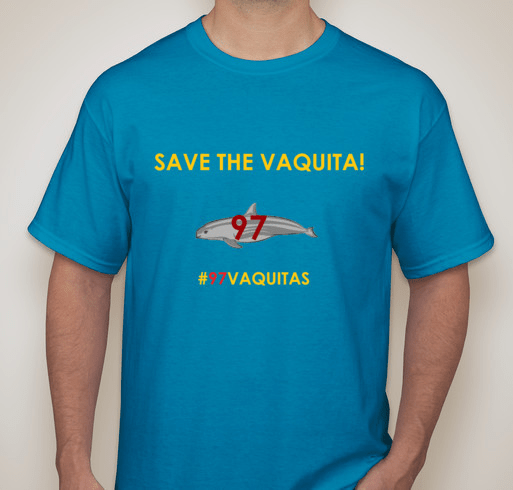
I would like to give a big thanks to everyone who bought a Vaquita t-shirt during the Muskwa Club’s campaign. All in all, we sold 47 shirts, raising $160.63 for the Muskwa Club. I hope everyone enjoys their t-shirts; I know I will! While we wait for them to ship, please keep your fingers crossed that the Mexican government’s upcoming Vaquita announcement will be a positive one!
Category Archives: Updates
Greenpeace
I just received an email from Greenpeace UK stating that their new Vaquita petition is the fastest-growing petition in Greenpeace history! They already have over 250,000 signers in 3 days, and it’s our job to keep that number shooting up. Please share this link to keep the heat on the Mexican government as they make their decision any day now about what their plans are for the Vaquita!
https://secure.greenpeace.org.uk/protect-the-vaquita3
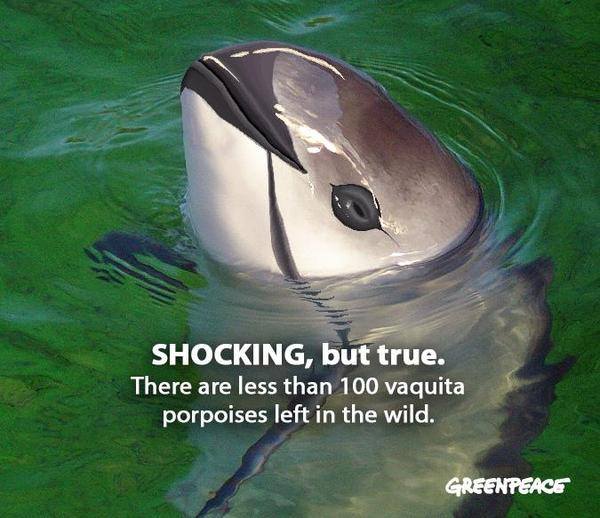
I am very pleased to say that Greenpeace is using one of my paintings for their social media outreach for this campaign!

I have noticed some misunderstandings about this picture. As I said when I posted this a while back, this is a digital painting/photo manipulation of a photograph of a captive harbor porpoise from the Netherlands. It has become by far my most popular artwork (it is near the top when you search ‘Vaquita’ on Google images), so I just wanted to clear up everything. I obviously did not intend to confuse anyone. Vaquitas cannot be kept in captivity for many reasons, so this kind of view of a Vaquita is impossible. I wanted to show what it would be like to see a real, alive Vaquita close up. And of course, I do not want to cause any problems for the original photographer.
But I am flattered that Greenpeace thought it was a real Vaquita. 😉
The last stand
“Few will have the greatness to bend history itself, but each of us can work to change a small portion of events. It is from numberless diverse acts of courage and belief that human history is shaped. Each time a man stands up for an ideal, or acts to improve the lot of others, or strikes out against injustice, he sends forth a tiny ripple of hope, and crossing each other from a million different centers of energy and daring those ripples build a current which can sweep down the mightiest walls of oppression and resistance.”
― Robert F. Kennedy
I want to be a Vaquita scientist when I grow up, not a conservationist. I don’t want to live in constant fear of the day that the Vaquita goes extinct. I want to go out on a boat and do research while admiring a mother and calf happily swimming.
And I certainly want to have Vaquitas to study.
These all require the Vaquita to not go extinct. In a way, me trying to help the Vaquita now (as a kid) is ensuring that my dreams of the future will come true. In essence, the Vaquita is my bank account; I am depositing money now (helping the Vaquita) so I can have a lot more in the future (study the now-abundant Vaquita).
I am sure there are many other people like me who wish to save the Vaquita, for various reasons. But the point is, we can’t realize this dream without all of us working together.
This is literally the final chance to save the Vaquita. They are right at the population size that has always been considered past the point of recovery. Without a voice like us, the Vaquita is doomed. This is our last stand.
“A last stand is a general military situation in which a body of troops holds a defensive position in the face of overwhelming odds. The defensive force usually takes very heavy casualties or is completely destroyed, as happened at Thermopylae, or Custer’s Last Stand. Bryan Perrett suggests that although the majority of last stands throughout history have seen the defending force overwhelmed, on rare occasions the outnumbered defenders succeed in their desperate endeavors and live to fight another day, and he lists the Battle of Rorke’s Drift as one such engagement.”

This has an eerie resemblance to our situation. But we need to replicate the Battle of Rorke’s Drift, not Thermopylae or Custer’s Last Stand. It will take a little luck, but we will have no chance unless we put forth our best effort.
To read more about what is happening, click this link: http://switchboard.nrdc.org/blogs/zsmith/this_week_in_whales_focus_ngos.html
And here is the letter that was sent to the Mexican President: http://switchboard.nrdc.org/blogs/zsmith/Letter%20to%20President%20Pe%C3%B1a%20Nieto%20FINAL.pdf
The Mexican government is scheduled to make their announcement about their official plans to save the Vaquita TOMORROW, so while you are feasting with your family or watching football, keep the little porpoises in the back of your mind, and maybe even shoot them a prayer.
A new way for you to help is through Greenpeace’s new campaign by sending a personal letter of your own to the Mexican president: https://secure.greenpeace.org.uk/page/speakout/save-the-vaquita?js=false
Please like VIVA Vaquita on Facebook for constant updates and links, and stay tuned to V-log to get the latest Vaquita info.
Finally, we have reached the minimum number of shirts sold in Muswka’s campaign, so everyone is guaranteed to receive their shirts! If you haven’t already, please purchase a limited edition Vaquita shirt for yourself or a loved one just in time for the holidays. There is less than a week left, but we are only 13 away from our goal! Please help us surpass our goal, because all funds go to the Muskwa Club, a leading Vaquita conservation group that is on the cutting edge of porpoise conservation and awareness. The only thing holding back Muskwa from succeeding in all of its many projects is funding, so buying this shirt really could save the Vaquita.
And it’s pretty stylish.
Animal welfare vs. Conservation
Please take a few minutes to read this intriguing piece by Andrew Wright, from Southern Fried Science:
“The ever-logical Spock once said “The needs of the many outweigh the needs of the few.” Then he didn’t. Then he did again. (Thanks J. J. Abrams.)
But I digress.
Regardless of which Spock you are listening to, the logic is still sound. For example, most people would agree that it is sometimes necessary to put a few people in harm’s way to protect the entire population of a nation. Likewise, a system that taxes a few of the world’s wealthiest to help out the masses is generally accepted as a good idea.
The logic also holds when it comes to helping endangered species survive and recover. Decision-makers essentially try to maximize the returns of their investments, making sure that the greatest number of animals are protected for the all-too-limited funds available to take on the task at hand.
So when the world went crazy over the death of Marius the giraffe in February of this year, many conservation biologists found themselves in a state of disbelief.
Of course, the vast majority of those in the business of conservation will freely admit that the welfare of animals in zoos and aquaria is important. They are in our care and we have an ethical obligation to look after them and make sure they remain healthy and happy. And this is especially true in the case of endangered species.
So what is the problem?
Well, the trouble is that conservation of wild animals is woefully underfunded.
Let us look at a case in point. In August a new report was released stating that the worlds’ smallest cetacean (a group that includes whales, dolphins and porpoises), the Vaquita, was down to just 97 animals and would likely to go extinct in the next four years. Crucially, all the necessary laws are in place; the solution is better enforcement and retraining of fishermen. And all this needs is money. And probably less than a movie star can make on a single movie.
On an environmental scale this is both tragic and a surprisingly easy fix. But, while a reasonable number of news agencies have covered the story, and continue to do so, the level of public outrage since that time can be best described as non-existent.
In another case, Suni, a 34-year-old male northern white rhino in the Ol Pejeta Conservancy, a wildlife conservancy in Kenya, died last week, leaving only six left in the world – all in captive facilities. The future of the species is now extremely bleak as Suni was one of the last two breeding males. And yet no-one seems to have noticed.
And therein lays the problem. We, as a society, cry foul over the perceived unethical treatment of animals that solidly inhabit our world, but apparently care little for those that live on the fringes. Consider that the western black rhino was officially declared extinct at the end of 2013, with very little fanfare, while the staff of Copenhagen Zoo received death threats over one giraffe from a healthy subspecies. The very existence of the Vaquita and both the northern white and Javan rhinos currently hang in the balance, while many other animals, including two other subspecies of giraffe, are also listed by the IUCN as endangered. But there is no shouting and screaming.
Meanwhile, public outcry caused huge amounts of money to be offered up to buy Marius and ship him off to another location. In a previous case, ridiculous sums of money were invested in the ultimately unsuccessful attempt to reintroduce Keiko (of Free Willy fame) back into the wild (although he did enjoy a probably extended retirement in a Norwegian sea pen).
One reason often given for this is that people identify with animals with names. Accordingly, the money spent on such individuals simply wouldn’t be available for conservation otherwise, as people would not have offered it up. However, the lack of response to Suni’s death seems to contradict this. As do two other recent examples, Satao, the largest elephant in the world, and another huge tusker, Mountain Bull, that were both killed by poachers in late May of this year. These magnificent and important animals had names, but despite some media coverage the outpouring of outrage simply did not materialize. So perhaps it is simply that people can only identify with those animals they can see for themselves.
It is right that we protect the rights of animals in our care. But we must also remember that all wild animals are likewise at the mercy of human actions. We kill them for a handful of trinkets. We tear down their homes. We pollute their food and water. But the overwhelming majority of animals suffering in such ways find no spontaneous offers of new homes; no funds being set up for their welfare and security; no celebrities tweeting about how horrible their treatment is.
Animal rights are an ethical issue. It is an issue that should receive our attention. But if animals do indeed have rights, then don’t we have an ethical obligation to uphold the welfare and safety of all animals?”
We absolutely do. We need the world to care about the little Vaquita. And frankly, almost nobody even knows about them. With celebrities being the people we all look up to the most, having one (or more) as an ambassador for the Vaquita would be a big deal. So please, while we in the Vaquita conservation world work towards this goal, you can as well.
Social media is quite the powerful tool…
Vaquita gift ideas
With the holidays right around the corner, now’s the time to start buying gifts for your loved ones. Money is tight these days, so gifts where some the proceeds go to a good cause is a great deal. Luckily for you, there are many such gifts that are related to the Vaquita! Let’s take a look.
The CEDO Eco Shop is a wonderful place to buy awesome gifts for the holiday season. From Vaquita t-shirts to booklets, to even a special link to Amazon that gives a portion of any purchase to CEDO, they have it all.
CEDO works extensively with the Vaquita, so it is one of the best charities to donate to.
Another wonderful holiday gift for that special someone would be CEDO wine, complete with one of six creatures of the Gulf on the label (of course including the Vaquita). And a portion of the proceeds goes to CEDO!
http://www.benefitwines.com/CEDO-Intercultural_c_1826.html
The VIVA Vaquita La Tienda has some wonderful Vaquita-specific items, with a new collection by Memuco: http://www.printfection.com/vivavaquita/NEW–memuco-vaquita-items/_s_583346
A perfect gift is the Adopt-a-Vaquita kit from Save the Whales. For $25 you get:
- An 8 x 10 glossy color photograph of a Vaquita in the wild
- Adopt-a-Vaquita certificate personalized to your specifications
- 4 page color newsletter about Vaquita
- A letter to the United Nations for your signature
- Save The Whales window sticker
- VIVA Vaquita window sticker
- A Vaquita dog tag necklace (suitable for all ages and both sexes)
With the second edition of the world’s only Vaquita book coming in the near future, you might want to keep it in mind: https://www.createspace.com/4268018
And my final suggestion is a Save the Vaquita! t-shirt from the Muskwa Club’s campaign, with 100% of the proceeds going to this non-profit. Remember, if 34 t-shirts are not bought, none will not be printed. So please, support a great cause and look stylish while you do it: https://www.booster.com/savethevaquita97
Silver linings
There’s no other way to put it. The Vaquita is in a terrible situation.
There are fewer than 100 remaining, and they all live in a relatively miniscule area. They have consistently declined for as long as we have known about the species, and it could be getting even worse. There is a lot of conflict among governments and NGO’s in terms of who wants to help the Vaquita and who doesn’t. However,
“A certain darkness is needed to see the stars.”
We must look at the silver linings of the very dark storm cloud that is the Vaquita’s situation.
The Mexican President, Enrique Peña Nieto, and his committees are being extremely helpful, which is obviously a huge step. There are many confidential progressions being made in the “Vaquita Headquarters,” many of which are positive.
Conservation group LightHawk will be “flying monthly aerial surveys over the northern Gulf of California” this year to monitor the fishing activities in the Gulf, both legal and illegal. This kind of surveillance is a major part of enforcing the new laws to protect the Vaquita: http://www.planeandpilotmag.com/products/whats-new/lighthawk-flies-to-help-save-endangered-porpoise.html
Some more great news is that the Colorado River has finally reunited with the Gulf of California. What this means for the Vaquita, it’s hard to say. But let’s just admire some great restoration work: http://voices.nationalgeographic.com/2014/05/19/a-sacred-reunion-the-colorado-river-returns-to-the-sea/
Another example of great Vaquita conservation is the San Diego Zoo: http://blogs.sandiegozoo.org/2014/10/31/helping-vaquita-porpoises/
The Clearwater Marine Aquarium, famous for their dolphin Winter (the subject of both Dolphin Tale movies), has started a major campaign to save the Vaquita: http://www.seewinter.com/get-involved/winters-hope-vaquita
Two more petitions that we would really appreciate you to sign are:
I have a second edition of my book in the works, so keep an eye out for that in the near future…
Finally, many of you remember the Vaquita Blanket Challenge. It was a challenge (much like the ALS Ice Bucket one) where we encouraged participants to get wrapped up in two blankets and try to escape in under 97 seconds (the number of Vaquitas left). Though there were some wonderful participants, many people either didn’t have the time to film themselves doing this or simply were embarrassed. Therefore, the t-shirt campaign for people who had taken the challenge did not thrive by any means. In light of this, I have created a new t-shirt campaign that isn’t related to the challenge. Please check it out, and hopefully purchase one for yourself or a loved one (it makes the perfect Christmas gift for that animal lover in your life). Our goal is 50 shirts, but I believe we can surpass that. 100% of profits go to the Muskwa Club, Inc., now an official non-profit organization, and you can even make an additional donation directly to them. The campaign runs the entire month of November, so you will receive the shirts by Christmas.
Thank you!
Vaquita Blanket Challenge
Get two twin bed size blankets. Lay on the first blanket with your feet crossed at the ankles like a Vaquita tail and your arms behind your back with your hands clasped at the small of your back. Have someone wrap you tightly (roll you up in) the first blanket and then the opposite way in the second blanket. Now, have someone time you trying to get out without rolling over, without standing up and with minimal use of your arms. Can you get out in 97 seconds? Post your time along with this message (and optionally a video or picture of you taking the challenge) on social media, email it to your friends, and nominate 3 other friends to do so as well. Did you feel momentarily trapped like a Vaquita might feel in a net? If you’ve taken the challenge, you are eligible to buy and wear the Vaquita Blanket Challenge T-shirt at: http://www.booster.com/vaquitablanketchallenge. You can also make a donation toward the Muskwa Club’s efforts to save the Vaquita. Wear your shirt with pride to help spread the word about the Vaquita before it’s too late!
Puppeteers
The fishing season has begun. It runs during every month that has the letter “r” in it, which is September to April.
Enormous actions need to be taken right now by the Mexican and US governments in order to save the Vaquita. This could be the last year with the Vaquita if the fishermen are allowed to fish in their range this season:
http://www.cnn.com/2014/08/19/opinion/vidal-endangered-vaquita/
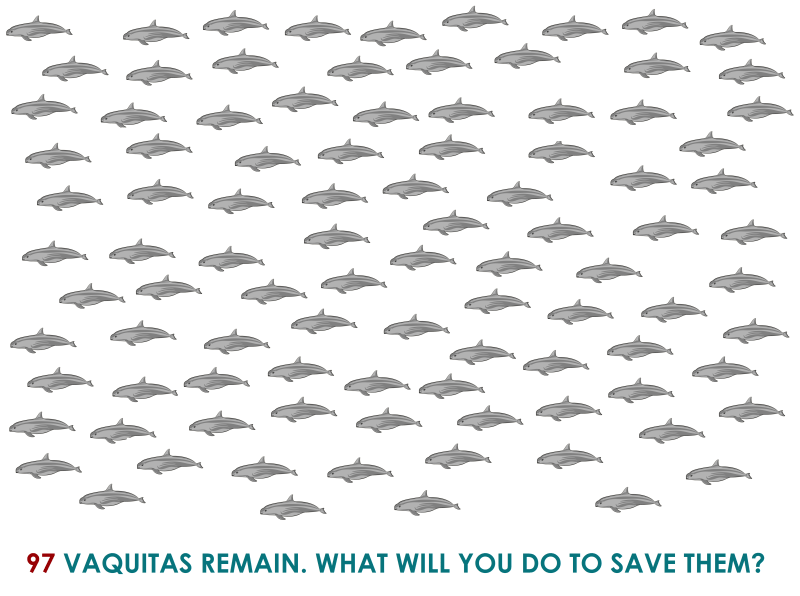
Our governments need to work together and make a decision now. Like puppeteers, they have complete control of the entire species, as I represented above. To help them make this historical decision, please sign this petition:
http://act.oceanconservancy.org/site/MessageViewer?dlv_id=41469&em_id=30824.0
Time for action
97. There are 97 Vaquitas left on this planet. For every Vaquita on earth, there are 82 million people.
To date, nothing that has been done to save them has worked. It is a harsh reality for all of us in the field of Vaquita conservation, and now there is the threat of Totoaba fishing for the Asian black market, which we didn’t think was occurring in substantial amounts anymore.
A big change is necessary if we plan on saving this species. We have been incredibly diplomatic with the fishermen, but obviously it has not been working. We need help from very important people, and we will certainly try our hardest to make that happen. Please read this message from ¡VIVA Vaquita!: http://www.vivavaquita.org/VV_Emergency2014.html.
¡VIVA Vaquita! is requesting that the Mexican Government do everything in its power (and make full use of assistance offered from other countries, such as the United States) to eliminate all gillnet fishing in the Vaquita’s range in the next two months. If this does not happen, we will immediately begin campaigning for a boycott of ALL Mexican seafood products, until such time that the ban is considered to be in effect.
Right now, the most important thing that the general public can do is sign and share this new petition from the Ocean Conservancy:
http://act.oceanconservancy.org/site/MessageViewer?dlv_id=41469&em_id=30824.0
It is vital that everyone shares the Vaquita’s predicament on social media before it is too late. If you have not already, “like” ¡VIVA Vaquita! on Facebook for important updates.
A good example of social media helping a cause is “Changing Hearts, Minds, and Lives.” They are a Facebook group (of which I am a member of) that uses social media to spread the word about important environmental issues, such as the Vaquita.
Countless major news companies have been attracted to the Vaquita’s story, but unfortunately, it’s because of how close to extinction it is. Hopefully this new level of recognition can have a positive impact on the species.
If you live near the Point Vicente Interpretive Center in Rancho Palos Verdes, CA, then please attend their book signing on Saturday, November 8th, from 11:00 am to 1:00 pm. Beth Whittenbury will be representing my book there, so please pay her a visit and buy my book! Thanks so much Mrs. Whittenbury!
Lauri Hamilton has submitted a video for National Geographic’s Expedition Granted program for a chance at a $50,000 grant to go out and film Vaquitas. Please vote for her on September 16 if she is one of the finalists! She used one of my drawings for the video, which I am very thankful for. Here is the link: http://expeditiongranted.nationalgeographic.com/project/the-vaquita-project/.
If we all work together to save the Vaquita, it really does have a chance…
Now is the time for action.
Bad news
I am deeply saddened by the news that there are likely less than 100 Vaquitas remaining on the planet, with under 25 of them being reproductive females. The International Vaquita Recovery Team, CIRVA, has just published the findings of their 5th meeting here: http://www.iucn-csg.org/index.php/2014/08/02/the-vaquita-new-report-from-cirva-released/, with more information coming soon from the Mexican Presidential Commission on Vaquita Conservation at this site: http://www.iucn-csg.org/.
The issue has quickly become a worldwide news story, being covered by the Washington Post (below) and ABC News among others.
The reason of their decline remains the same: accidental capture due to illegal gillnet fishing. But it now appears that there is a culprit more damaging than the shrimp fishery: Totoaba. A critically endangered species in its own right, Totoaba has been illegally hunted for years due to the incredibly high market value of their swim bladders. Particularly in China, these organs are a delicacy that can fetch over $10,000 per bladder. The temptation is simply too good to be true for the local fishermen, no matter how illegal it may be. As one of NOAA’s Vaquita experts Jay Barlow says, “With two days of fishing, you can buy a new pickup truck.”:
We all feel a little hopeless right now. It seems almost impossible to save the Vaquita. But I’m here to tell you that the fight is not over. Everybody has fought too hard for too long to give up now. These next few years could go down in history as the biggest success story in conservation history if we can turn things around. It is now in the hands of our governments, so we need to do something to get them to permanently remove gillnets from the Vaquita’s range. Hopefully there are some petitions in the works, so in the meantime, please use social media to our advantage. Spread the word in any way you can. It will be unexplainably devastating if we lose the Vaquita, so please, everybody, we need to work together and do something to save everyone’s favorite little Mexican porpoise. Check back here for the latest updates on the situation. Thank you.