Last Call at the Oasis

I just received an email from TakePart, creators of Change the Course, which I wrote about in a previous post, about a documentary that is making its television premiere Sunday. Here is what the email states:

“‘Informative, fast-moving and scary’—that would be a great way to describe a hungry Grizzly Bear taking you through a PowerPoint presentation, but we’re not talking bears today. We’re talking about the film Last Call at the Oasis and that is how the New York Times described this powerful documentary.

This visually stunning film by Academy Award® winning filmmaker Jessica Yu is an integral inspiration point for the Change the Course campaign. It shatters myths and lifts the veil behind our most precious resource…and most importantly, it’s making its television premiere this Sunday night, Aug. 25, at 8pm ET on Participant Media’s new TV network Pivot.

Find Pivot in your area and watch Last Call at the Oasis!”

So please, watch this and learn everything you can about our disappearing water! Maybe it will talk about the Colorado River and the Vaquita! Click “Find Pivot” to figure out what channel number it will be, and get your popcorn ready for Sunday night!

Perspective

This weekend I did a lot of catch-and-release fishing with my cousins in Barnegat, New Jersey, where I was able to witness firsthand many fish and almost as many ways to catch them. We caught at least 35 fish from 5 different species.

The experience was interesting for me in a few ways. First, I learned a lot about fishing. Since this exact activity is what is wiping out the Vaquita, an animal that I am dedicating a large portion of my life to, I want to learn everything I can about the other side of the duel. When I am getting ready for a tennis tournament, I don’t just work on my own game, I also study my opponent and how he plays. We need to do the same exact thing for the Vaquita vs. Fishermen matchup. That means listening to the fishermen. They are not our enemy. They are just humans doing their job. Unfortunately, their job is wiping out an entire species. We need to fully understand both sides of the dilemma in order to solve it. I have been researching a lot about gillnets, pangas, and everything about fishing in the Gulf. The simple answer is: they will not be able to stop fishing, so we need to get them to use Vaquita-safe gear. Fortunately, as you probably know, the Mexican government has announced that all shrimp gillnets will be switched to Vaquita-safe trawls within the next 3 years. Albeit a huge step, it is only the first of many needed to save the Vaquita.

The second way the experience was interesting was the sheer number of animals that we pulled out of a small bay during a few hours of fishing. At least 35. Or a flock of starlings I saw on the ground today of at least 200 birds. I then realized how vulnerable the number 200 is when you are talking about population. That flock of birds could fly into a reflective glass building and be gone. Just like that. There are at most 200 Vaquitas left on the planet. Gillnets are the Vaquita’s reflective glass building. Theoretically, the Vaquita could go extinct tonight. But hopefully they are still here tomorrow, so we can get to work on getting every last gillnet out of the Gulf of California and hanging them up forever.

The third way it was interesting is that I was able to put myself in the fishermen’s shoes. I pretended that I was a fisherman and that I needed to catch fish in order to feed my family. It really changed my perspective on the situation. I realized how fishing is anything but a hobby for the Gulf fishermen. It is absolutely a job, and a competitive one at that. As leading Vaquita expert Barbara Taylor once said of fishing in the Gulf, “If you don’t catch any shrimp, your neighbor will.” When I put myself in the fishermen’s situation, there was a new urgency to catch each fish, and I can only imagine what the pressure is like in real life. If I were them, I would use the best gear possible and nothing else. Fortunately, the Vaquita-safe trawls are as effective as gillnets, but more expensive. We need more awareness, therefore money, towards the Vaquita and the switch-out program. So please, spread the word and raise money in any way you can possibly think of. I would love to hear your ideas and questions in the comments section. Thank you!

The olden days

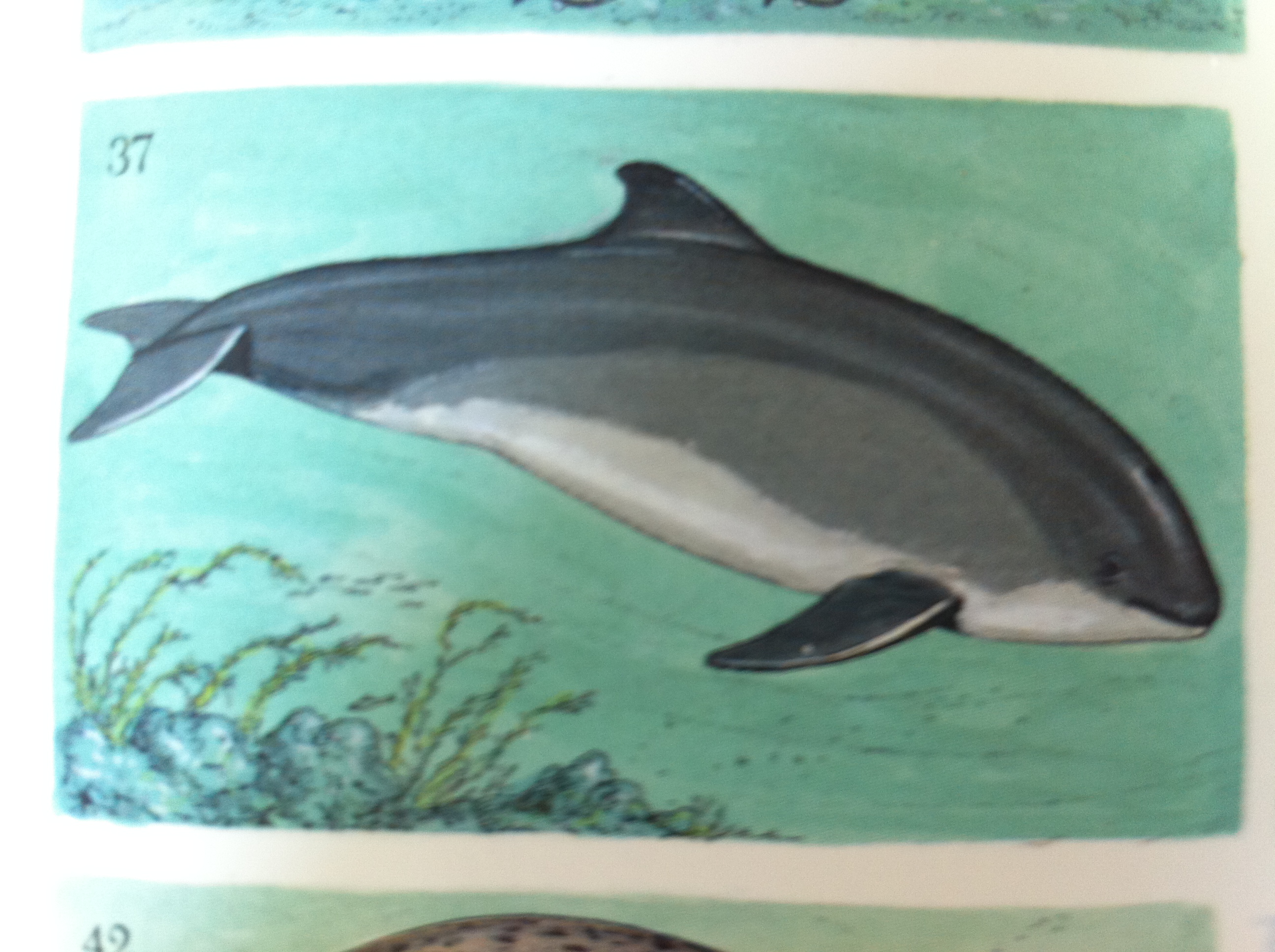
This weekend I am on vacation in Sandy Hook, New Jersey. While exploring the famous lighthouse, we found a gift shop that contained many ocean-related objects. When I was checking out the books, I was astonished when I found the “Whales and Dolphins Coloring Book” by John Green. I immediately recognized the book (because of my past internet research) as one of the only in the world that contains the Vaquita. This book was published in 1990, before the Vaquita’s appearance was well-known. To give you a feeling of how much we have learned about the Vaquita in the last 20 or so years, here is what the Vaquita’s coloring page looks like:

20130810-181511.jpg

And here is their example of the Vaquita:

Example from 1990

They didn’t even know that the Vaquita had eye- and mouth-patches, as well as the chin-to-flipper stripe and a triangular dorsal fin. The Vaquita was discovered in 1958 from a few skulls, and first seen in 1985. We still have so much to learn, but it will not be possible to learn anything if we lose them now.

It’s not time to let go

Okay, so I found a link to an article in a New York Times blog post. The article, here, by Erik Vance, is on an extremely personal and controversial topic:

Should we let the Vaquita go extinct?

I had to close my eyes and calmy inhale to even make it through the article. The answer is absolutely, positively, no way in the world, not in a million years, no. He says that perhaps we should let the Vaquita go in order to get the fishermen on board with saving other endangered species of the Gulf. I am not sure if/how that would even work, but there is no way that the scientists and conservationists who have worked on saving the Vaquita for their entire careers would just let the Vaquita ‘slip away.’ I am not arguing with the fact that the Vaquita is in a tough situation right now, and that there has been phenomenal effort by the Mexican government to seemingly little avail. I am not arguing with the fact that the Vaquita is a life-changing ‘nuisance’ to the fishermen that they will likely never see in their entire lives, yet they have been very cooperative with NGOs and the government for the most part.

But this is about the big picture. The Vaquita cannot be a canary in a coal mine. It is not an option for us to learn from our mistakes on the Vaquita. We have already lost the Baiji because of human activities. Those beautiful dolphins were sacrificed so we could learn what not to do with an endangered species. The Vaquita is the test. If we can save the Vaquita, we can do anything. Tigers, pandas, rhinos, polar bears, and every other endangered species can benefit from us saving the Vaquita, not letting it go extinct. The Baiji has already filled that role.

It is also about the little picture. The Vaquita simply deserves to live. If you were born before 1958, then the Vaquita was discovered in your lifetime. Now it could go extinct within the next few years. Your life could completely encompass our knowledge of the existence of an entire species. We definitely do not want that. The Vaquita as an animal is extremely unique. We will absolutely never have a species like the Vaquita again if we lose Phocoena sinus.

So the real question is, “Now that we know the Vaquita can’t go extinct, how are we going to save it?” In June, an enormous step was taken by the Mexican government in the form of a new regulation that will phase out all shrimp gillnets to Vaquita-safe trawls within the next 3 years. This is great news, but this doesn’t mean our work here is done. The government still has to pull through with their promise, as well as develop safe trawls for finfish, not just shrimp. For now, you can help the Vaquita by raising awareness, not buying seafood caught in gillnets, and raising money towards the switch-out program. For more details, visit https://vlogvaquita.com/2013/07/14/update-the-big-3/.

So my point is, there is no way we can give up, especially after all this time and effort. This is where we need to explore the limits of human teamwork to save something that’s not a human. The Vaquita has never done anything to us, so why should we accept murdering every last one? This adorable, innocent little porpoise deserves every drop of blood, sweat, and tears we can squeeze out of ourselves. And even if the Vaquita does eventually go extinct, I could not live with myself knowing that we didn’t try our hardest to rescue it.

We need to at least, as my tennis coach would say, go down swinging.

First donation details

A huge thanks to everyone who bought my book in its debut month! I am going to send a check of 25% of my earnings to ¡Viva Vaquita! (like I will for every future month), along with additional money going to other Vaquita causes, like the all-new switch-out charity (see post below for link).

________________________________________________________________

Here are the details of the donation:

Between June 28 and July 30, I sold:

19 books online (15 via https://www.createspace.com/4268018, and 4 via Amazon.com), equaling $117.13

and 21 books in person, equaling $280.00

for a total of $397.13

and an average of $9.93 per book

Total donation to ¡Viva Vaquita!: rounded up to $100

________________________________________________________________


So for my first month of the book, I will be donation $100 to ¡Viva Vaquita!, leaving $297.13 for other organizations and future endeavors of us and the Muskwa Club.

Now it is time to get ready for next month’s donation! If you haven’t already bought the book, or you want more, please purchase as many as you would like from https://www.createspace.com/4268018. Thank you!